
This article was created with the AI assistant Claude and published by Peter Hoenig.
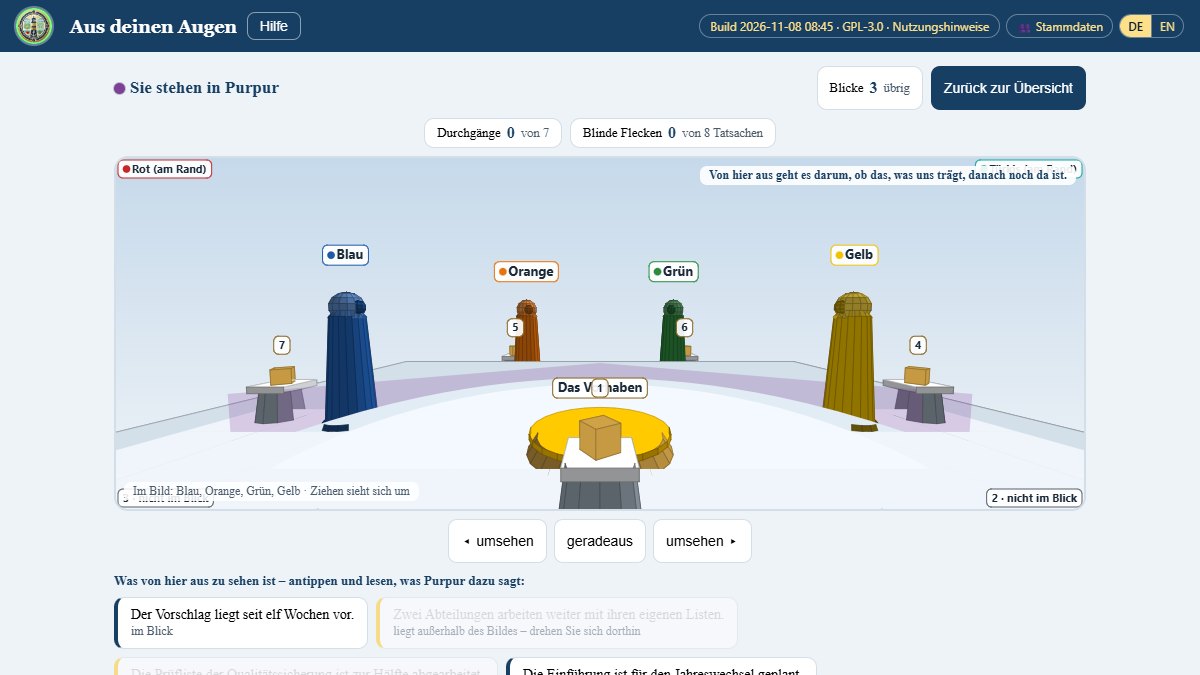
What looks like hesitation from red is care from blue. What seems like braking from orange is, from purple, the protection of something that has grown. You can read that sentence out and everyone will nod. Experiencing it is harder – unless you actually go and stand there. That is exactly what this game does: Through Your Eyes, free in your browser, in 3D.
The blind spot is not chance, it is geometry
The seven colours stand evenly on a circle and look towards the centre, at the initiative. Behind each colour lies exactly one of the eight facts; the eighth lies in the middle. From that, without any additional rule, it follows that every colour overlooks its own fact and those of its two neighbours, and its two neighbouring colours stand so far to the side that it does not have them in view. Five of the fifteen things in the room lie outside its field of vision.
That has a side effect I only noticed while playing, and then kept: orange does not see the cost overrun by itself. It lies behind green, and green is orange’s neighbour. The colour that always asks for the number has to turn around first to find precisely that number. That is how blind spots work – they do not sit where you are weak, they sit where you do not look.
What you cannot see, you cannot read
Looking around is free. But reading something that lies outside the natural field of vision costs a look – and you have three per walkthrough against five blind spots. The real exercise is therefore not to know a colour’s sentences, but to know where it does not look.
One observation from the walkthroughs: yellow and turquoise speak more kindly about the other colours than the rest do about each other. That is intentional and it is not a ranking. What one colour says about another is always its own view, not the truth about the other. With a systemic view and a view of the whole it is simply easier to recognise another colour’s logic instead of judging it. Both have their own exaggerations – distance, impatience with other ways of thinking, aloofness, neglect of the everyday.
The decision at the end
Five options are always available, from “go live at the turn of the year as planned” to “stop and start again in two years”. Each one carries some colours and rolls over others, and each colour tells you what it makes of it. Colours you did not stand in speak up anyway – with what you would have heard there.
There is a sixth: a wording that carries all seven. It is not the compromise that hurts everyone a little; it takes from each colour exactly what matters to it. It becomes available if you have stood in all seven colours and turned into a blind spot for at least five of the eight facts. In the Values Prism that is called being able to speak out of yellow.
What the game explicitly does not do
It sets up parts, not types. All seven figures are exactly the same size – no colour is better than another, and there is no ladder upwards. The game does not tell you which colour you are, does not classify anyone, does not assess personality, does not measure aptitude and is no basis for decisions about people. The values model after Clare W. Graves is a model for reflection and dialogue, not a diagnostic instrument. Company, roles, figures and plot are entirely invented.
Who is this for?
For coaches and consultants as a way into perspective work. For managers who want to see a stuck decision from every side. And for every meeting in which someone claims the others have not understood the facts – usually everyone has the same facts and is simply standing somewhere else. I also work with the underlying format live: in business coaching, in team development and in enterprise architecture management.
In short
Free as free software, independently implemented: Open Through Your Eyes. The companion games: Seven Voices takes the same situation from the outside – twelve rounds, one action per round, and it is the weakest voice that counts –, The Spiral shows why the colours are not a ladder, and The Valley takes the journey through the U. If you would like to experience a constellation of this kind with your team, I am happy to talk about it in a free initial consultation.
“Through Your Eyes” sets up parts, not types: it does not classify anyone, does not assess personality and is no basis for decisions about people. Spiral Dynamics® is a registered trademark of National Values Center Consulting; the name here refers only to the underlying model.
Open or download the tool
- Through Your Eyes (game)Open Download (380 KB)
Thinking further
You can find more on this topic under Ressourcen und Downloads – or talk to me directly in a free initial consultation.