
This article was created with the AI assistant Claude and published by Peter Hoenig.
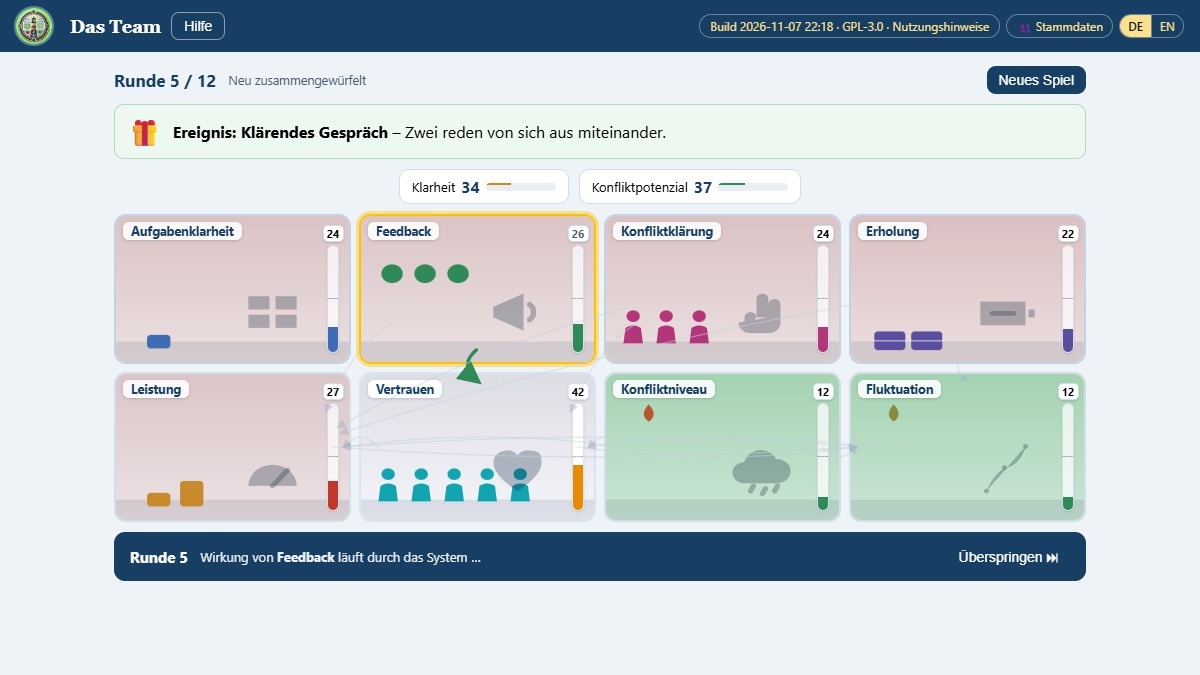
There is a sentence I hear very often in teams: "We are actually a good team, there is just a lot going on at the moment." Usually both halves are true. And usually something grows alongside that nobody mentions. The Team turns that into a game: twelve rounds, four levers, and one quantity you cannot see at first. In your browser, free of charge, with nothing transmitted.
The storming phase cannot be skipped
That is the central message of the game, and the reason I built it. Avoiding conflict does not give you less of it – it gives you the same conflict later. And then clearing it costs a multiple: in the game, a conflict cleared early costs around one round of performance; the same conflict six rounds later costs three.
The tricky part is that the avoidance strategy feels good for a long time. The level of conflict stays low, performance is fine, and you make progress. The problem only becomes visible once it is no longer a silent quantity. That is why the game only shows the conflict potential from a certain point onwards – exactly as in real life.
The phases of team development described by Bruce Tuckman – forming, storming, norming, performing – inspired this dynamic and are mentioned descriptively only. The game explicitly does not tell you which phase your team is in, and it is not a grid to sort a team into. All its quantities describe a played team as a whole; it says nothing about individual people.
Why feedback is the most important lever although it works slowest
At first, feedback produces nothing visible: it costs time, and trust only rises a round later. But in the game trust is not one resulting quantity among others – it is the factor by which all other levers are multiplied. A team with low trust gets less performance out of the same task clarity.
That matches what I see in practice: in teams with trust, simple measures work surprisingly well. In teams without trust, almost everything fizzles out, including very well-meant measures.
And recovery?
The lever that gets cut first when things get tight. In the game, high performance without recovery creates attrition, and above a threshold somebody resigns. That then costs more in a single moment than the saved recovery time ever brought in – trust, clarity and performance at the same time. Anyone who has seen that in points does the sums differently afterwards.
Who is this for?
For team leads who want to know what their favourite strategy does over a year. For workshops on personal and team development: a year in twenty minutes, after which people talk differently about "we have no time for that". And for everybody who suspects that something is lying around in their team that nobody says out loud.
In short
Free as free software, independently implemented: Open The Team. How networked thinking works I explain with no prior knowledge in Networked thinking – why simple cause and effect often leads you astray. If something is lying around in your team that would be better discussed, do get in touch for a free initial consultation.
"The Team" is a simplified model for reflection and conversation about team dynamics – not a diagnostic instrument, not a forecasting tool and not a basis for decisions about people.
Open or download the tool
- Das Team (Simulationsspiel)Open Download (325 KB)
Thinking further
You can find more on this topic under Ressourcen und Downloads – or talk to me directly in a free initial consultation.