
This article was created with the AI assistant Claude and published by Peter Hoenig.
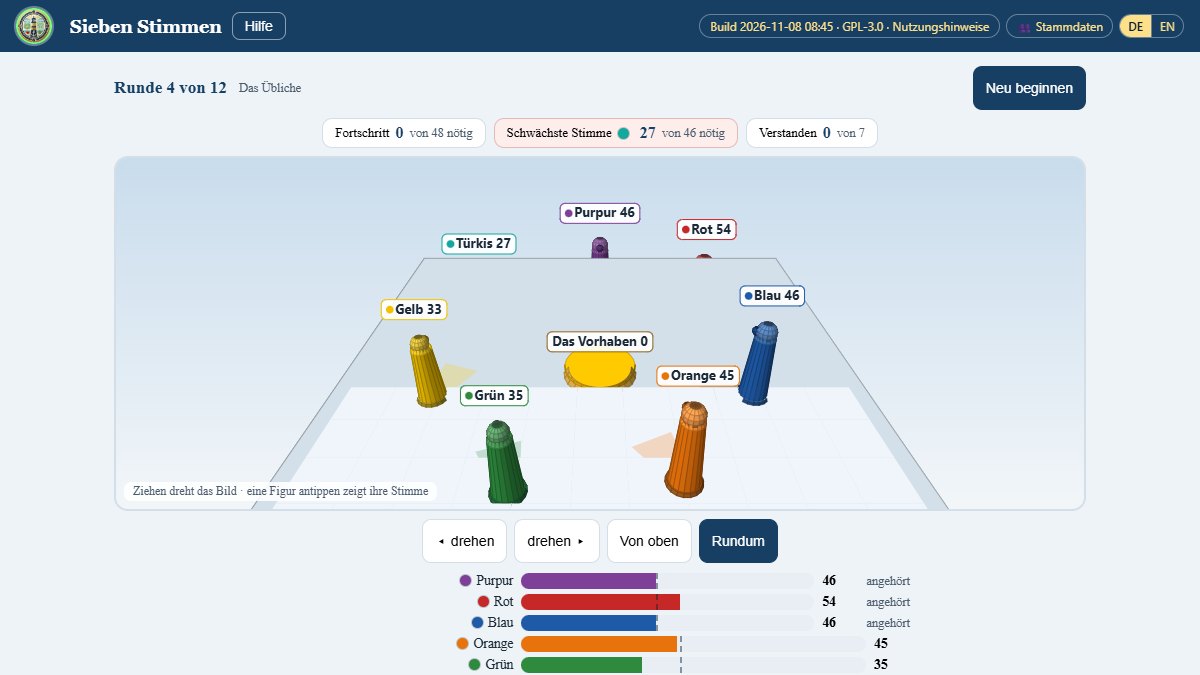
“We have to get faster,” says the management. “First we need clear rules,” says quality assurance. “And who is asking the people?” asks the works council. Seven voices, all of them right from where they stand – and in the end it is not the loudest cheer that decides, but how low the quietest one is. I turned that into a game: Seven Voices, free in your browser, in 3D, with nothing transmitted.
Why the obvious strategy fails
The obvious strategy is to serve the loudest voices: set a date, push through, show the costs, measure. It produces a great deal of progress – and in my measurements it ends at 2 points out of 100 on all three difficulty levels. Not because too little happened, but because purple and green drop below 10 in the process, and the weakest voice is the score.
The second most obvious approach is to spread everything evenly and use each action once. Measured: 0, 17 and an early collapse. Anyone who only proceeds gently – involving, honouring, listening – ends up with contented voices and an initiative that has not moved a single step. That is a defeat too, and one I see often in practice.
What works is a combination the game never explains: genuinely understand three or four voices, then act firmly. The difference is not small. Without any understanding, the attainable ceiling is 35, 37 and 27 points – below every threshold. With four voices understood, it is 54, 56 and 50. Depending on the starting position that is a difference of 19 to 23 points, and it comes solely from saying the same thing differently.
The second wording
That is the twist I was after. “We save four hundred hours” is spoken from orange. The same thing from green is: “Four colleagues get their Fridays back.” And from blue: “The procedure will be documented so that it can be followed.” Nothing is prettified and nothing is two-faced – it is the same fact, fanned out like light in a prism.
In the game you do not get this second wording for free. You listen to a voice – which costs one of your twelve rounds – and then interpret what it is really about. The two wrong answers are exactly the two mistakes that happen in everyday life: mistaking the reaction for the concern (“purple does not want change”), or attributing another colour’s concern to it (“blue wants everyone to be asked” – that would be green). Interpret wrongly and the round is spent anyway, and the voice feels misread.
Understanding all seven would cost seven of twelve rounds. Then there is too little time left to actually move the initiative forward. That is precisely the decision the game asks of you: whom do you understand – and whom can you afford not to understand?
What the game explicitly does not do
It sets up parts, not types. It does not tell you which colour you are, it does not classify anyone, does not assess personality, does not measure aptitude and is no basis for decisions about people. No colour is better than another, and there is no ladder upwards: without red nothing happens, without blue nothing holds, without orange nothing is paid for, without green nobody carries it. In a real meeting the same person speaks from different colours depending on the topic.
The values model after Clare W. Graves is used here as a model for reflection and dialogue, not as a diagnostic instrument. Company, roles, figures and plot are entirely invented.
How it connects to the Values Prism
The game is the playable version of a constellation format I call the Values Prism: the seven colours are set up as figures, and size, distance and direction of gaze show how they relate to one another. That is why the playing surface looks like my 3D systemic board – the resemblance is deliberate, but this is a game and not a second editor. If you want to know which colours are strong in your own organisation, the free values profile questionnaires are the better starting point.
Who is this for?
For everyone who has to get initiatives through organisations: project leads, architects, managers, consultants. Twelve rounds take about twenty minutes, and afterwards you talk differently about the sentence “they are just against it”. In workshops on team development and in business change management I ask the same question: which voice is currently standing at four?
In short
Free as free software, independently implemented: Open Seven Voices. The companion games: Through Your Eyes shows the same scene from all seven colours – there the camera sits inside the figure –, The Spiral shows why the colours are not a ladder, and The Valley takes the journey through the U. If you have an initiative where one voice is not coming along, I am happy to talk about it in a free initial consultation.
“Seven Voices” sets up parts, not types: it does not classify anyone, does not assess personality and is no basis for decisions about people. Spiral Dynamics® is a registered trademark of National Values Center Consulting; the name here refers only to the underlying model.
Open or download the tool
- Seven Voices (game)Open Download (378 KB)
Thinking further
You can find more on this topic under Ressourcen und Downloads – or talk to me directly in a free initial consultation.