
This article was created with the AI assistant Claude and published by Peter Hoenig.
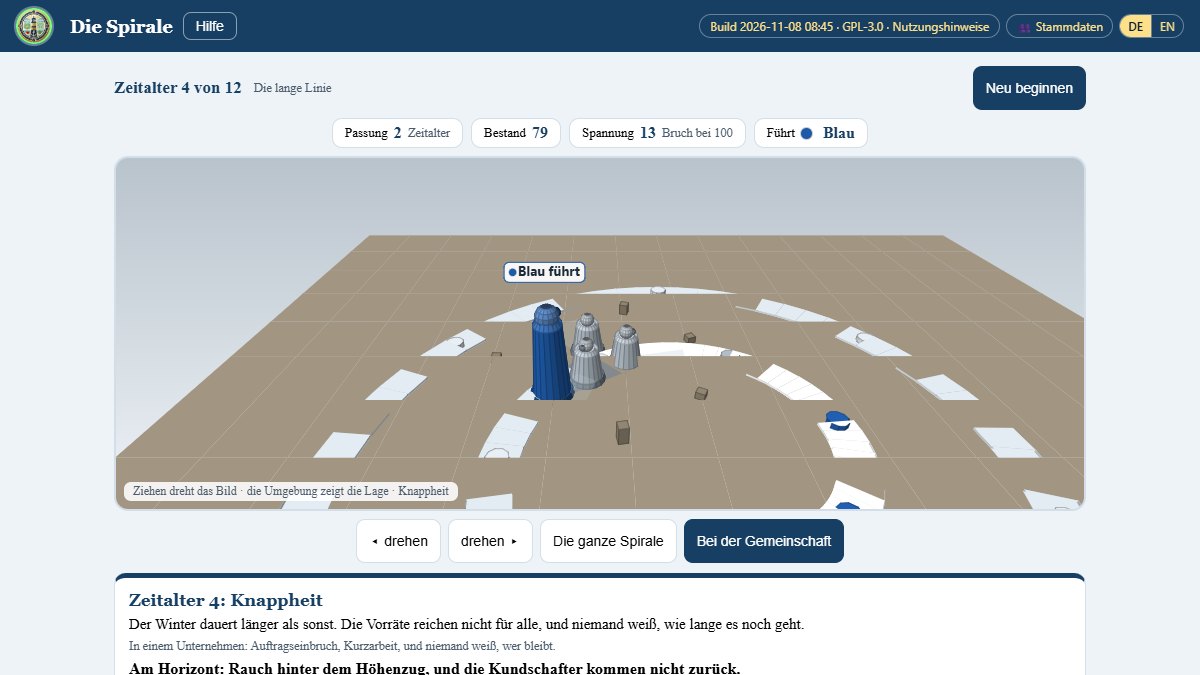
Clare W. Graves found something that almost always gets lost in the retelling. What usually survives is the image of a ladder: purple at the bottom, turquoise at the top, and whoever stands higher is further along. That is not what Graves meant. His finding was: value systems emerge as an answer to life conditions. When the conditions change, the answer no longer fits — regardless of where it sits in the sequence. I turned that into a game: The Spiral, free in your browser, in 3D.
Why the ladder is mechanically impossible
It mattered to me that the game should not forbid the usual misreading with a notice, but rule it out through its rules. That is why each colour is the answer to exactly one condition and to no other. Checked by calculation: each of the seven fits fully in exactly one of seven situations, and across all situations none scores more than five of fourteen possible points.
And the sequences of conditions are deliberately not built in the order of the colours. On the first level, purple is the right answer in the tenth age, long after yellow. That is not a regression. It is a scarcity, and in scarcity it is cohesion that carries.
The hard part: catching up
Recognising the situations is the smaller exercise. The catch sits elsewhere: a culture that fitted its conditions no longer fits after the change — and switching costs. In the game a switch only takes effect in the next age, just as in real life an organisation does not change over on a Monday. Whoever waits until the new situation has already arrived loses a whole age.
That is why there are signs: at the end of each age you see what is coming. And that is why switching becomes more expensive the longer a colour has been leading — and also when the last switch was only just made. Together that means you cannot follow every change.
Measured, it looks like this: anyone who only switches once the new situation has arrived scores 4, 0 and 0 points across the three difficulty levels and breaks apart early every time. Anyone who follows every sign manages all twelve on the easiest level — and tears the community apart on the two harder ones through the cost of switching. There it is no longer about hitting everything, but about leaving out the right things.
No colour carries across all situations
Anyone who relies on a single colour and sticks with it scores one to four points out of twelve — whichever colour it is. Turquoise included; it is the answer to one situation, interdependence, and to no other. That is the point at which I learned the most while checking the numbers.
What the game explicitly does not do
It sets up parts, not types. It does not tell you which colour you are, does not classify anyone, does not assess personality, does not measure aptitude and is no basis for decisions about people. The values model after Clare W. Graves is a model for reflection and dialogue, not a diagnostic instrument. Community, situations and examples are entirely invented and do not depict any historical development.
Who is this for?
For everyone who works with the values model and has to explain why it is not a ranking — twenty minutes of play save half an hour of argument. For managers who have to bring an organisation through a change of conditions. And for team development and business change management, where the question is usually not which culture is the better one, but which one fits what is actually at hand.
In short
Free as free software, independently implemented: Open The Spiral. I describe the format behind it in The Values Prism; the companion games are Seven Voices and Through Your Eyes. If the conditions are changing in your organisation right now, I am happy to talk about it in a free initial consultation.
“The Spiral” sets up parts, not types: it does not classify anyone, does not assess personality and is no basis for decisions about people. Spiral Dynamics® is a registered trademark of National Values Center Consulting; the name here refers only to the underlying model.
Open or download the tool
- The Spiral (game)Open Download (347 KB)
Thinking further
You can find more on this topic under Ressourcen und Downloads – or talk to me directly in a free initial consultation.