
This article was created with the AI assistant Claude and published by Peter Hoenig.
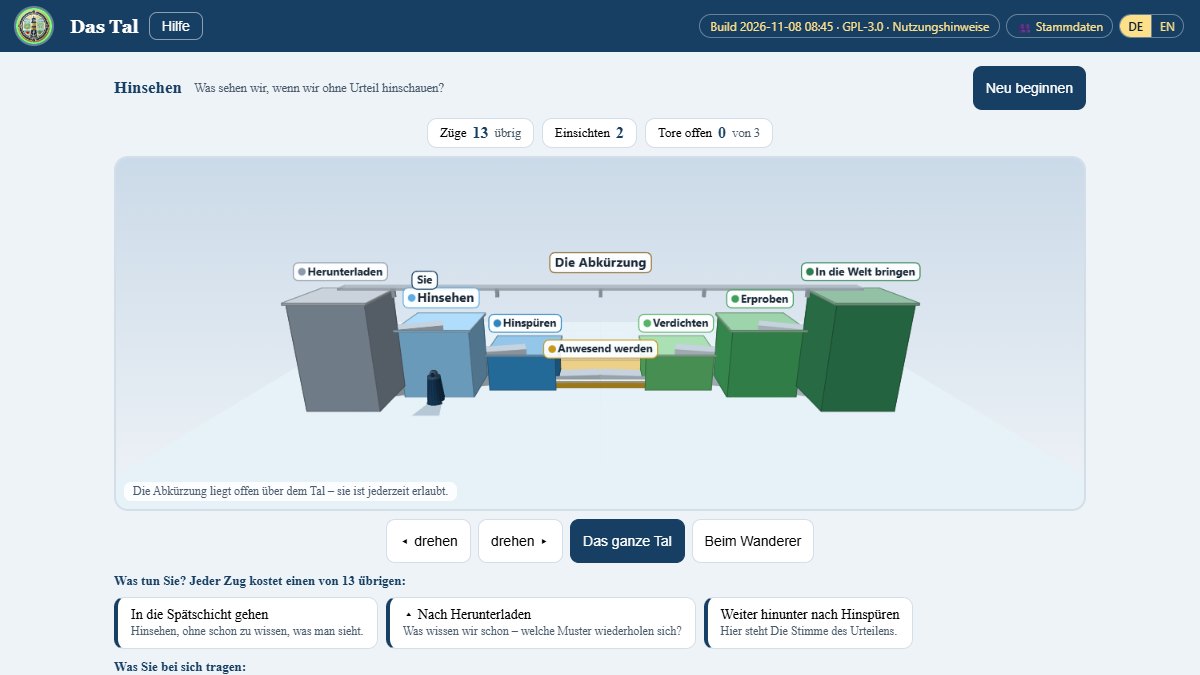
The most effective way to get someone to a better solution is not to forbid the worse one. It is to let them take the worse one and then let them see what they did not see. This game is built exactly that way: The Valley, free in your browser, in 3D.
The shortcut is not a trap
That mattered to me. The bridge across the valley is visible from the first second, clickable at any time, and delivers a solution that holds. It is what C. Otto Scharmer calls downloading: acting out of what you already know. In the game it is worth 42 points out of 100 — not zero. The workshop gets a filing system, search time drops a little, nobody calls it a failure. That is how most decisions turn out, and that is how they are meant.
The full way through the valley measures 94. Everything in between exists too: look briefly and then take the shortcut and you reach 58; add one outside perspective and you reach 64. Every step down pays off, even half of one.
And the descent can go wrong. Try twice to force a gate and you are left standing in the valley with 15 points — clearly worse than the bridge. Gather too thoroughly and try to take everything with you, and you run out of time. That is precisely why the shortcut is not decoration but a real and reasonable choice.
The gates cannot be won
This is the part I spent longest on. The three voices — “you know perfectly well what the problem is”, “we have tried all this before”, “then we will look like the people who got it wrong for four years” — are not a fight in this game. You can argue against them, refute them, bypass them or talk the matter up. Every one of those attempts throws you back and costs two moves. You argue with the voice and thereby agree with it that this is a place for arguing.
What works instead is not a stronger answer but an open one — and it requires something:
- An open mind needs two things you have genuinely observed. Without that, nothing has shaken your judgement, and goodwill alone does not shake it.
- An open heart needs two outside perspectives. Disappointments cannot be refuted; they want to be heard.
- An open will needs you to give something up — an insight you already hold. It is gone afterwards, and you may miss it up top. It is the only point in the game where you voluntarily become poorer.
What does not exist for you
At the end, when anchoring, the game lists the solutions that were not available to you, and what they would have needed. Not as a punishment, but because that is the whole point: the best solution in this game is not cleverer than the others. It was simply nowhere to be seen except down in the valley — the late shift had had it all along, and nobody had looked.
Scharmer’s key sentence, which the game turns into a rule: the quality of a result depends on the inner place from which one acts.
What the game explicitly does not do
Theory U is used here as a model for reflection and dialogue, not as a diagnostic instrument. The game does not classify anyone, does not assess personality and does not measure aptitude. The three voices are not a statement about you but figures in the model; the fear in the game is a professional one, not a personal one. Coaching is not psychotherapy (§ 1 para. 3 of the German Psychotherapists Act). Situation, characters and examples are entirely invented.
Who is this for?
For everyone who facilitates workshops along Theory U and has to explain why you cannot simply start at the bottom. For managers to whom “we know what the problem is” sounds familiar. And as a warm-up for my free 3D U-process, in which teams walk the same path with a topic of their own — described in detail in The U-process.
In short
Free as free software, independently implemented: Open The Valley. The companion games on the Values Prism are Seven Voices, Through Your Eyes and The Spiral. If a decision is coming up where everyone already knows the outcome, I am happy to talk about it in a free initial consultation.
Trademark notice: Theory U® and Presencing® are registered trademarks of C. Otto Scharmer (US reg. 5883933 and 5135923). The names refer here only to the underlying model; there is no connection with the trademark owners or with the Presencing Institute, and this game is neither certified nor authorised by them.
Open or download the tool
- The Valley (game)Open Download (352 KB)
Thinking further
You can find more on this topic under Ressourcen und Downloads – or talk to me directly in a free initial consultation.