
This article was created with the AI assistant Claude and published by Peter Hoenig.
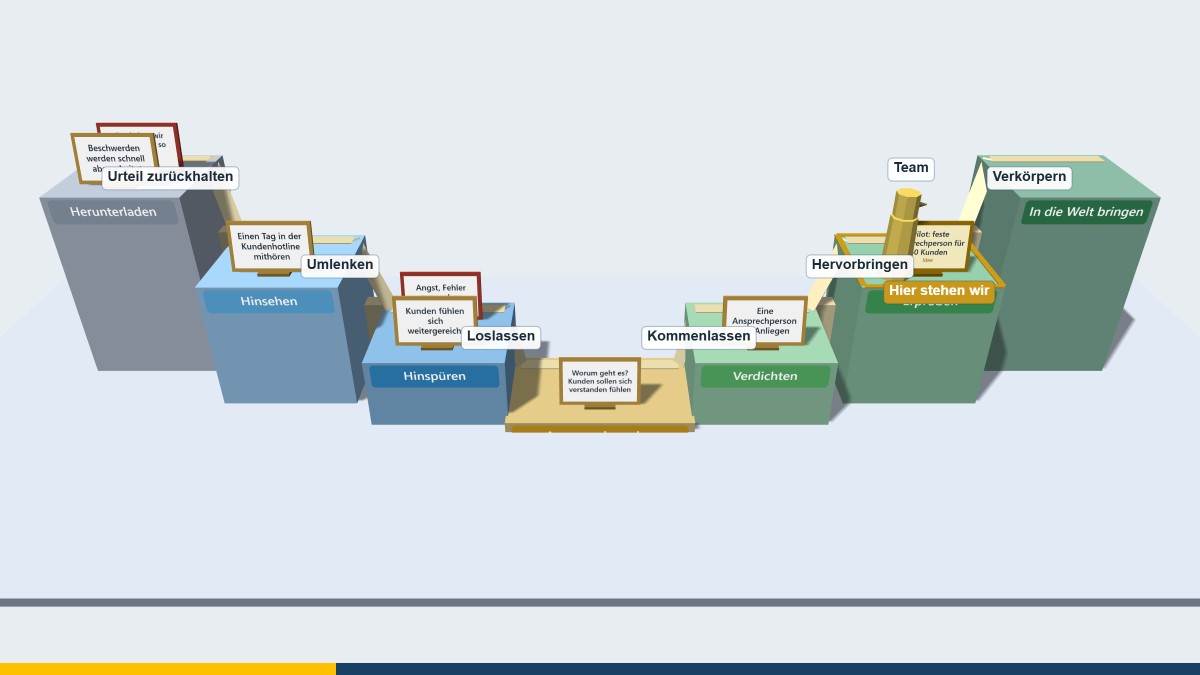
Many changes fail because people act too quickly: the problem has barely been named before the familiar solution is on the table. Theory U describes a different path. It first leads downwards – looking more closely, putting yourself in others' shoes, pausing – and only then back upwards, to ideas, prototypes and implementation. For teams that want to develop something genuinely new, in particular, the U provides helpful orientation.
At a glance
- Theory U was developed by C. Otto Scharmer and describes how something new can emerge.
- On the left of the U, the path goes down: from habitual downloading through seeing and sensing to presencing.
- On the right, it goes back up: crystallising, prototyping, bringing into the world.
- Three inner voices – judgement, cynicism and fear – can hold the path back.
- The free U process editor records what has been gathered at each station; in 3D, the U becomes a landscape you can walk through.
Purpose of the method
The U distinguishes between the ways in which we meet a situation. When downloading, we only see what we already think anyway. When seeing, we perceive facts that do not fit our picture. When sensing, we try to experience the situation from the perspective of others. At the deepest point, presencing, what we previously took for granted recedes – and what really matters becomes apparent. On the way up, this turns into an idea (crystallising), a first small-scale trial (prototyping) and finally something that holds up in everyday practice (bringing into the world).
Between the stations lie gestures such as “suspending judgement”, “letting go” and “letting come”. And there are three inner voices that make the path harder: the voice of judgement, the voice of cynicism and the voice of fear. Recognising them is already an important step.
Where the method comes from
C. Otto Scharmer, a lecturer at the Massachusetts Institute of Technology (MIT), developed Theory U from interviews with leaders and experts and from research projects on organisational learning, including work with Peter Senge, Joseph Jaworski and Betty Sue Flowers. He described it in detail in 2007 in “Theory U”, published in German in 2009 under the title “Theorie U – Von der Zukunft her führen”. For change initiatives in groups, he also summarises the path in five movements.
How to work with the U
- Clarify the question together: what do we really want to understand or change?
- Do not take shortcuts on the left-hand side of the U: look closely, talk to the people affected, experience the situation from their perspective.
- Pause: what has now become clear to us? What do we want to let go of?
- Crystallise ideas and try them out on a small scale – better an early prototype than lengthy planning.
- Transfer what proves its worth into everyday practice.
- Along the way, name the voices that hold you back instead of letting them guide you.
Working with the U process editor
- Two templates: seven stations with the gestures in between, or five movements for change initiatives in a team – starting together, perceiving together, pausing, trying out together, bringing into the world. When you switch templates, the cards move to the matching station.
- Gathering: add cards at each station; guiding questions help.
- Naming what holds you back: mark cards as an inner voice – judgement, cynicism or fear.
- Showing progress: move the active station on; completed stations are marked.
- Ideas and prototypes as a separate card type; with a second picture you can record a later state, such as “after the pilot”.
- Saving and export: save as a file, a printable report, export as PDF, PowerPoint, LibreOffice Impress, Visio, SVG, PNG and as a table for Excel.
The editor runs entirely in your browser and does not transmit any data. It is free of charge and available as free software under the GPL: Open the U process editor in your browser.
The U as a landscape in 3D
In the 3D version, the path through the U becomes a landscape: the stations are platforms that lead down on the left and back up on the right, the cards stand on them, and a figure shows where the team currently stands. From the figure's point of view, you can look along the U – back along the path the team has already travelled and ahead to what is still to come. An earlier and a later state can be compared side by side, and files can be transferred between the board and the 3D version. Open the 3D U process in your browser.
If you would like to assess where an organisation or a person stands on the path through the U, you can use my questionnaires on Theory U – for organisations and for individuals. They use the same terms as the editors; they are trial versions that have not yet been scientifically validated.
In coaching, Theory U serves as a model for reflection and dialogue, not as a diagnostic instrument. Coaching is no substitute for psychotherapy.
Conclusion
The U is a reminder that good solutions often only emerge after good listening. If you would like to shape a change initiative in your team in this way, I will be glad to support you with business change management and team development. Contact me for a free initial consultation.
Sources: Scharmer, C. O. (2007): Theory U. Leading from the Future as It Emerges. Cambridge, MA: Society for Organizational Learning. – Scharmer, C. O. (2009): Theorie U – Von der Zukunft her führen. Heidelberg: Carl-Auer. – Senge, P.; Scharmer, C. O.; Jaworski, J.; Flowers, B. S. (2004): Presence. Human Purpose and the Field of the Future. Cambridge, MA: Society for Organizational Learning.
Thinking further
You can find more on this topic under resources and downloads – or talk to me directly in a free initial consultation.
Comments
Comments are published immediately with your name. Only the name, title, comment text and time are stored – see the privacy policy.
Loading comments …