
This article was created with the AI assistant Claude and published by Peter Hoenig.
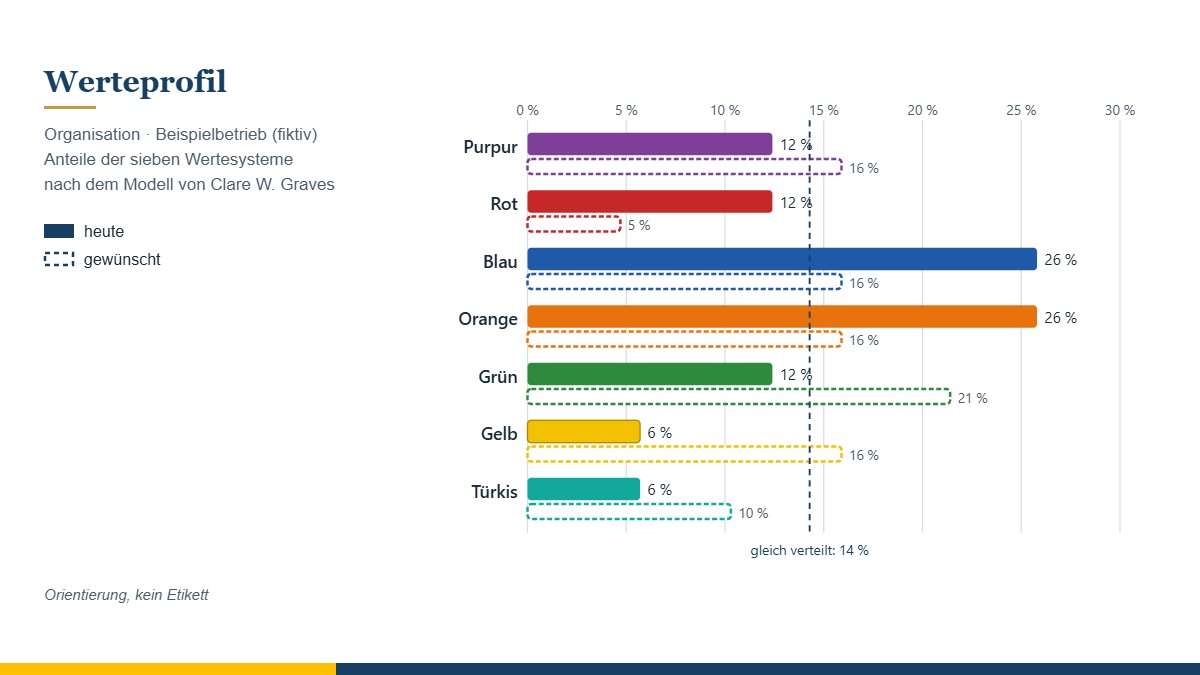
Why does one person feel at home in a company straight away while another never does? Why does a well-planned change founder on “We've always done it this way”? The answer often lies in values: in what matters to people and organisations, what they reward and what they take for granted. My two values profile questionnaires make this visible – for an organisation or for yourself.
At a glance
- The values profile shows how much weight seven value systems carry today – in an organisation or in a person.
- It is based on the values model of Clare W. Graves, which has become known as Spiral Dynamics.
- If you wish, it also shows the desired state and behaviour under pressure.
- The result is orientation, not a label: every value system has its strengths and can be taken to excess.
- Both questionnaires are free, run in the browser and do not transmit any data.
The model behind it
From the 1950s onwards, the American psychologist Clare W. Graves studied how people's values develop. He concluded that value systems emerge in response to the prevailing conditions of life – and that several of them are at work in every person and every organisation. Don Beck and Christopher Cowan developed his model further and made it widely known in 1996 under the name Spiral Dynamics; they assign colours to the value systems.
My questionnaires cover seven of these value systems:
- Purple – belonging and a sense of safety: cohesion, loyalty, rituals that provide security.
- Red – strength and drive: energy, courage and pace, especially in crises and at times of new beginnings.
- Blue – order and duty: reliability, structure and fairness through clear rules.
- Orange – achievement and progress: goal orientation, innovation, efficiency and entrepreneurial spirit.
- Green – community and humanity: appreciation, participation and social responsibility.
- Yellow – systemic, flexible thinking: recognising connections, competence rather than rank.
- Turquoise – wholeness and connectedness: meaning, sustainability, responsibility beyond one's own boundaries.
Every value system has its strengths – and its excesses: order can turn into bureaucracy, achievement into overexploitation, community into endless consensus-seeking. That is why no colour is better than any other. What matters is whether the mix suits the tasks, the people and the environment. I do not ask about the basic drive for survival, which Beck and Cowan call beige, because it hardly plays a role in everyday life.
In my 8-Level Model, I use the model to talk about the culture of teams and organisations – as a model for reflection and dialogue.
Two questionnaires: organisation and individual
Organisational values profile: ten topics – from basic character, leadership and decisions, dealing with employees, cohesion, strategy, measures of success, rules and procedures, information and communication, and mistakes and learning through to change and new things. You can look at the whole company or at one area of it.
Personal values profile: ten topics from your own life – what gives me stability, how I make decisions, work and success, rules and requirements, relationships, what drives me, conflicts, learning, change and meaning.
In both questionnaires, each topic has two statements for each value system: 140 statements in about 20 minutes in the full version, 70 statements in about 10 minutes in the short version. You answer on a scale from “not at all” to “completely” or “very much”. For each statement, an example shows what an answer means in everyday life. Two additional perspectives are possible:
- Desired state: this is how it would be good for us – or how I would like to be.
- Today under pressure: how things actually are in crises and under time pressure. According to Graves, earlier value systems then often come to the fore.
The result
The profile shows the share of each value system; together they add up to 100 per cent, and with an even distribution each would have about 14 per cent. An interpretation names the main emphases without turning them into a label. For each value system there is a card with its strengths, its excesses and a question for discussion – for example: “Which rules really support us – and which have outlived their usefulness?” In addition, there is the balance between “I” and “we” and, where recorded, the comparison with the desired state and with behaviour under pressure.
It becomes particularly revealing when several people complete the questionnaire for the same organisation: where the profiles diverge, the real conversation begins. With the personal profile, comparing it with the profile of your own organisation helps you to understand why you feel comfortable in some places and experience friction in others.
Data and notes
The questionnaires run entirely in your browser. Your answers are not transmitted to me or to anyone else. You can save your interim progress as a file on your device at any time, print the result, save it as a PDF or keep it as a file. Both questionnaires are free of charge and available as free software under the GPL:
If you would like to look at values together with the way people perceive and act, you will find both in the values U compass.
The questionnaires are trial versions and have not been scientifically validated. They are intended as orientation and as a starting point for conversation – as a model for reflection and dialogue, not as a diagnostic instrument. Coaching is no substitute for psychotherapy.
Conclusion
A values profile does not say how an organisation or a person ought to be. But it helps you to understand what sustains you today, what is missing and where development could go – and it makes differences something you can talk about. I welcome feedback on the questionnaires; it helps me to develop them further. If you would like to discuss the result or bring together several perspectives in your organisation, I will be glad to support you in personal and team development. Contact me for a free initial consultation.
Sources: Graves, C. W. (2005): The Never Ending Quest. Ed. by C. C. Cowan and N. Todorovic. Santa Barbara: ECLET Publishing. – Beck, D. E.; Cowan, C. C. (1996): Spiral Dynamics. Mastering Values, Leadership, and Change. Malden: Blackwell.
Trademark notice: Spiral Dynamics® is a registered trademark of National Values Center Consulting. The name is used here solely to refer to the underlying model; there is no connection with the trademark owners, and my questionnaires are neither certified nor authorised by them.
Thinking further
You can find more on this topic under resources and downloads – or talk to me directly in a free initial consultation.
Comments
Comments are published immediately with your name. Only the name, title, comment text and time are stored – see the privacy policy.
Loading comments …