
This article was created with the AI assistant Claude and published by Peter Hoenig.
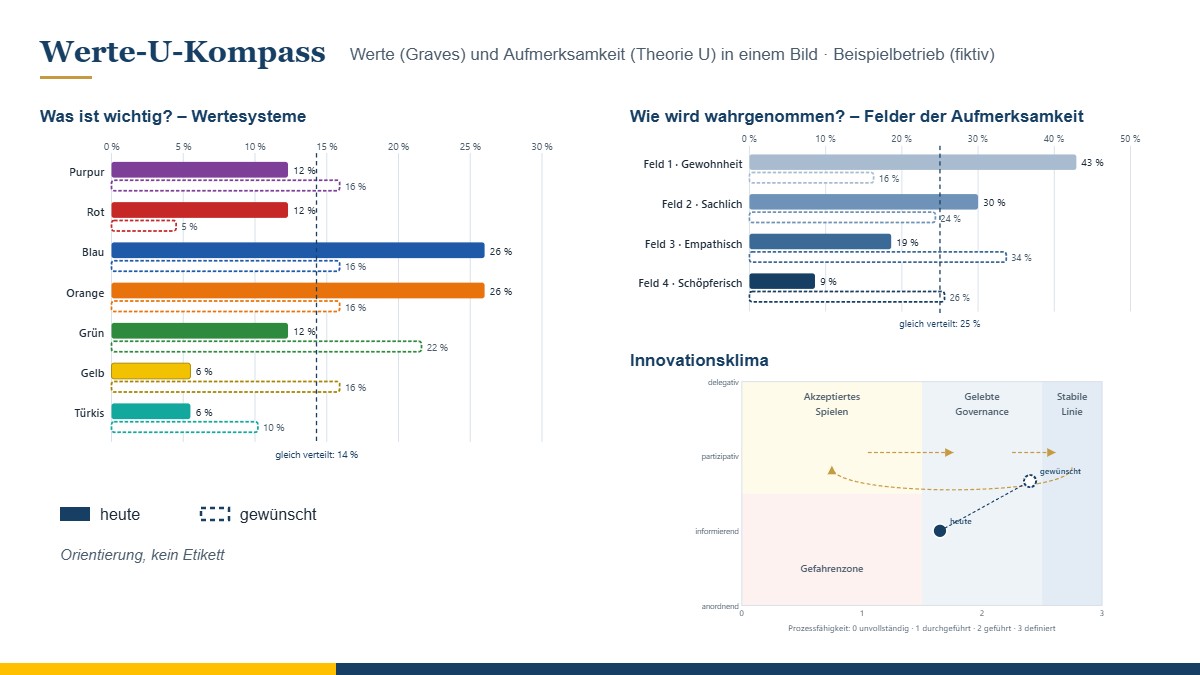
“People are at the heart of everything we do” – you will find this in many mission statements. Whether it is lived in everyday practice shows elsewhere: in meetings, in decisions, in the way mistakes are handled. Between what matters to an organisation or a person and the way things are actually perceived and acted upon, there is often a gap. The values U compass makes both visible in one picture – and shows which next development step suggests itself and how it can succeed.
At a glance
- The compass combines two models: the value systems according to Clare W. Graves (known as Spiral Dynamics) and the fields of attention according to Theory U by C. Otto Scharmer.
- It asks: what is important? How do we perceive? Do the two fit together? What is the next step – and are the conditions for it in place?
- For organisations, an assessment of the innovation climate is added.
- Several results for the same organisation can be merged.
- The questionnaire is free, runs in the browser and does not transmit any data.
Why two models together?
Graves's values model uses colours to describe what matters to people and organisations – belonging, drive, order, achievement, community, systemic and holistic thinking. Theory U describes how people perceive and act – out of habit, factually, empathically or generatively – and in which steps something new emerges. Each model is helpful on its own; together they answer a question that each leaves open by itself: is what matters to us actually lived?
For example, anyone who places a high value on community and participation but mainly acts out of habit in meetings is not living up to their own values in everyday life. The connection between the two models is my own interpretation; the compass marks it as such in the result. I describe the two models in more detail in the posts The values profile and The U profile.
How the compass is structured
At the start, you choose whether you are looking at an organisation – the whole company or one area of it – or at yourself, for example to prepare for coaching. The questionnaire then guides you through several parts:
- Values: as in the values profile, across ten topics.
- Attention: the four fields in eight everyday situations.
- Steps in the U process and what holds you back: learning barriers or inner voices.
- Situation, change and conflict: which kind of complexity prevails, whether the conditions for change are in place and how differing interests are dealt with.
- Warning signs: indications of what Scharmer calls “absencing” – such as mistrust, covering oneself, blame or withdrawal.
- Processes and leadership (organisations only): how reliable processes are and how people are led.
The standard version comprises 146 statements for organisations (about 21 to 27 minutes) and 134 for individuals; the full version covers each colour and each field twice as often. Optionally, you can also state the desired state and how things actually are today under pressure. You can save your interim progress at any time.
What the result shows
- What is important? The values profile with the shares of the seven value systems and the balance between “I” and “we”.
- How do we perceive? The shares of the four fields of attention.
- Do values and attention fit together? Which fields would be expected on the basis of the values and which are actually lived – with the largest deviations.
- The situation: whether dynamic, social or emergent complexity predominates, as Scharmer distinguishes them, and which approach then fits.
- Development path: the most natural next development impulse, together with the field of attention and the U step that support it. The compass checks whether the conditions for it are in place using the six conditions for change described by Don Beck.
- Steps in the U process, obstacles and warning signs.
- Innovation climate (organisations only): a picture based on the reliability of processes and the prevailing leadership style – directive, informing, participative or delegating. It assigns the organisation to one of four fields – danger zone, accepted play, governance in practice or stable line – and shows the path from the current to the desired state, with suitable approaches. I developed this model in my master's thesis at the Europäische Fernhochschule Hamburg; you can find it under E-books.
Finally, there are questions for discussion – in the team or with me.
Bringing several perspectives together: if several people complete the compass for the same organisation and save their results as files, all the files can be opened together. The result then shows the average and how far the respondents agree. This, too, happens only in your browser.
Data and notes
The questionnaire runs entirely in your browser. Your answers are not transmitted to me or to anyone else. The result can be printed, saved as a PDF or kept as a file. The compass is free of charge and available as free software under the GPL: Open the values U compass.
The values U compass is a trial version and has not been scientifically validated. It is intended as orientation and as a starting point for conversation – the result is a snapshot, not a label. I use the values model and Theory U as models for reflection and dialogue, not as diagnostic instruments; coaching is no substitute for psychotherapy.
Conclusion
The compass shows whether what matters is also lived – and where the next step can lead. It brings together my work with values and Theory U and is being developed continuously; feedback is very welcome. If you would like to discuss the result or bring together several perspectives in your organisation, I will be glad to support you with business change management and in personal and team development. Contact me for a free initial consultation.
Sources: Graves, C. W. (2005): The Never Ending Quest. Ed. by C. C. Cowan and N. Todorovic. Santa Barbara: ECLET Publishing. – Beck, D. E.; Cowan, C. C. (1996): Spiral Dynamics. Mastering Values, Leadership, and Change. Malden: Blackwell. – Scharmer, C. O. (2007): Theory U. Leading from the Future as It Emerges. Cambridge, MA: Society for Organizational Learning. – Hoenig, P. (2014): Modellentwicklung und Ableiten von Vorschlägen zum Fördern und Durchsetzen von Innovationen in IT-Abteilungen und IT-Unternehmen. Master's thesis, Europäische Fernhochschule Hamburg.
Trademark notice: Spiral Dynamics® is a registered trademark of National Values Center Consulting. The name is used here solely to refer to the underlying model; there is no connection with the trademark owners, and my questionnaires are neither certified nor authorised by them.
Thinking further
You can find more on this topic under resources and downloads – or talk to me directly in a free initial consultation.
Comments
Comments are published immediately with your name. Only the name, title, comment text and time are stored – see the privacy policy.
Loading comments …