
This article was created with the AI assistant Claude and published by Peter Hoenig.
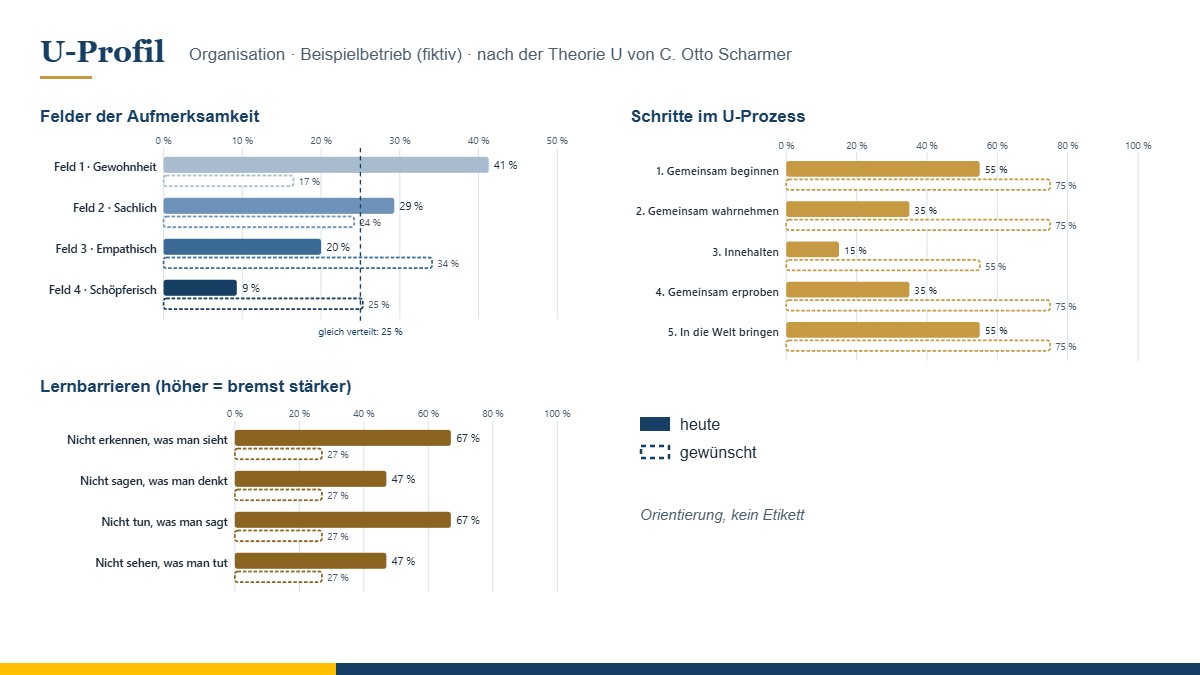
Two teams are given the same task. One briefly discusses what it already knows and implements the tried-and-tested solution. The other first talks to the people affected, listens carefully and then tries out something new on a small scale. Both work hard – but from a completely different stance. Theory U calls this the quality of attention. With my U profile questionnaires, organisations and individuals can assess how they perceive things today, how well they master the path towards something new and what holds them back along the way.
At a glance
- The U profile is based on Theory U by C. Otto Scharmer.
- It shows from which of four fields of attention people perceive and act – from habit to the generative.
- It assesses the five steps of the U process and names what holds them back.
- There is one questionnaire for organisations and one for individuals, each with an optional desired state.
- Both questionnaires are free, run in the browser and do not transmit any data.
The model behind it
C. Otto Scharmer, a lecturer at the Massachusetts Institute of Technology, starts from the premise that the quality of results depends on the quality of the attention from which people act. He distinguishes four fields:
- Habitual: you confirm what you already know.
- Factual: you pay attention to facts and strive for the best argument.
- Empathic: you see through the eyes of others.
- Generative: together you sense what wants to emerge.
All four have their place – habit saves energy, a factual approach creates clarity. What helps is being able to switch between them depending on the situation. For change in groups, Scharmer describes the path through the U in five movements: starting together, perceiving together, pausing, trying out together and bringing into the world. What holds this path back I summarise as four learning barriers for organisations and, for individuals, as the three inner voices that Scharmer describes. You can read more about the U process itself in the post Theory U in coaching.
What the questionnaires cover
Part 1 – Fields of attention: in eight everyday situations. For organisations, these are listening, meetings, decision-making and leadership, organising and coordinating, customers and partners, learning, disruptions and crises, and new ideas and innovation; for individuals, listening, conversations, decisions, collaboration, learning, crises and upheavals, creating something new, and one's inner attitude.
Part 2 – Steps in the U process: how well do you manage to start together, to perceive, to pause, to try things out and to embed what has proved its worth?
Part 3 – What holds you back: for organisations, four learning barriers – not recognising what you see; not saying what you think; not doing what you say; not seeing what you do. For individuals, the three inner voices of judgement, cynicism and fear. Here, the higher the value, the more strongly it holds you back.
The organisational questionnaire comprises 96 statements in its full version (about 15 minutes) and 50 in the short version (about 8 minutes); the personal questionnaire has 93 and 48 statements respectively. If you wish, you can also state how things should be, and how they actually are today under pressure – according to Scharmer, perception and conversation then easily slip back into habit. For each statement, an example shows what an answer means in everyday life.
The result
The profile shows the shares of the four fields – with an even distribution, each would have 25 per cent – and, for each topic, which field is strongest there. The steps in the U process appear as agreement in per cent, with a suggestion for the weakest step. For the obstacles, comparing today with the desired state shows where the greatest leverage lies; for each obstacle there is a note on what counteracts it, such as curiosity against premature judgement. A rough assignment of the fields to the value systems according to Clare W. Graves is marked as my own interpretation.
Data and notes
The questionnaires run entirely in your browser. Your answers are not transmitted to me or to anyone else. You can save your interim progress as a file on your device at any time, print the result, save it as a PDF or keep it as a file. Both questionnaires are free of charge and available as free software under the GPL:
If you would also like to look at values, you will find both together in the values U compass.
The questionnaires are trial versions and have not been scientifically validated. They are intended as orientation and as a starting point for conversation. I use Theory U as a model for reflection and dialogue, not as a diagnostic instrument; coaching is no substitute for psychotherapy.
Conclusion
If you know the stance from which you perceive and decide, you can change it deliberately – and allow something new to emerge instead of merely repeating the familiar. I welcome feedback on the questionnaires. If you would like to discuss your result or shape a change process based on Theory U, I will be glad to support you with business change management and team development. Contact me for a free initial consultation.
Sources: Scharmer, C. O. (2007): Theory U. Leading from the Future as It Emerges. Cambridge, MA: Society for Organizational Learning. – Scharmer, C. O. (2009): Theorie U – Von der Zukunft her führen. Heidelberg: Carl-Auer.
Thinking further
You can find more on this topic under resources and downloads – or talk to me directly in a free initial consultation.
Comments
Comments are published immediately with your name. Only the name, title, comment text and time are stored – see the privacy policy.
Loading comments …