
This article was created with the AI assistant Claude and published by Peter Hoenig.
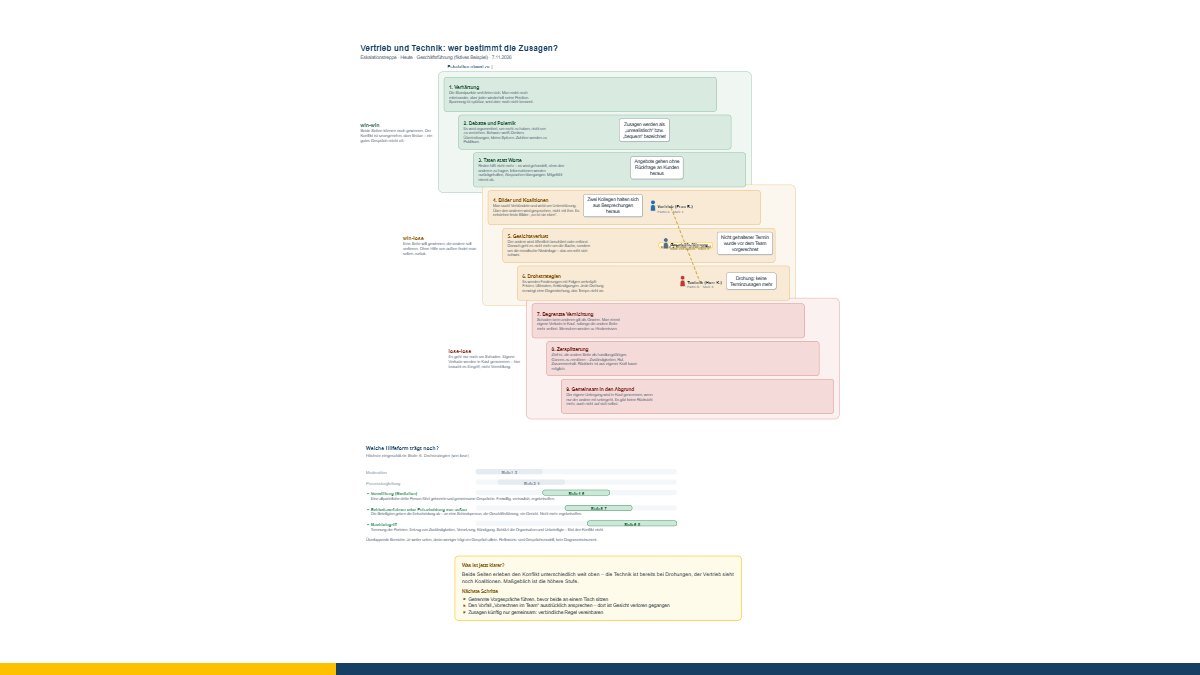
Among my coaching tools there was not a single one for conflicts. That gap gave me pause – because in small and medium-sized companies conflict is one of the most common reasons to call anyone in at all: two partners who can no longer agree. Sales against the workshop. Father and successor. So there is now the escalation ladder – a tool that answers one question, but a decisive one: where does this conflict stand right now?
How do I recognise which stage a conflict has reached?
The short answer: by what those involved do, not by how loud it is. Friedrich Glasl described nine stages, and each has a sober, observable characteristic:
- Hardening – people still talk to each other, but everyone repeats their position.
- Debate and polemics – people argue to be right, not to understand.
- Actions instead of words – people act without asking the other side. Information is held back.
- Images and coalitions – people look for allies. The other person is talked about, not talked to.
- Loss of face – someone is publicly shamed. After that it is about the moral defeat, no longer about the matter itself.
- Threat strategies – demands are tied to consequences: deadlines, ultimatums.
- Limited destruction – damage to the other side counts as a gain; losses of one's own are accepted.
- Fragmentation – the aim is to destroy the other side as a functioning whole.
- Together into the abyss – one's own downfall is accepted as long as the other side goes down too.
The decisive break lies between stages 3 and 4. Up to that point it is about the matter at hand and both sides could win. From stage 4 onwards it is about the people – and from there, well-meant persuasion no longer helps; it often even speeds things up.
Why two figures, not one?
This is where the tool differs from a diagram. In practice the two sides are never on the same stage. Someone who has already reached stage 6 – “if this carries on, I will not promise any more dates” – experiences a friendly invitation to talk very differently from someone who is still at stage 3 and wonders why everyone has suddenly become so tense.
So you place each party separately. The tool highlights the difference and names it in the analysis. Almost always that difference is itself a topic of the conversation: both sides are right about what they experience.
What then counts for the question of what still helps is the higher stage. Not the average, not your own assessment – the higher one. Someone standing at stage 6 brings their behaviour with them, however moderate the other side may be.
Which help still works?
That is the real yield. Below the picture the tool shows five forms of help with deliberately overlapping ranges:
- Facilitation (stages 1–3): those involved talk to each other themselves, someone holds the frame – order, time, fairness.
- Process guidance (2–4): several sessions: clarify concerns, examine the images each side holds of the other, put agreements in writing.
- Mediation (4–6): an impartial third person holds separate and joint conversations. Voluntary, confidential, open-ended.
- Arbitration or a decision from outside (5–7): those involved hand the decision over – to an arbitrator, to the management, to a court. No longer open-ended.
- Forceful intervention (6–9): separating the parties, withdrawing responsibilities, transfer, dismissal.
The overlaps are deliberate: a stage does not decide on its own, but it limits what is still possible. And a forceful intervention – I say this explicitly – protects the organisation and the uninvolved. It does not resolve the conflict.
What the tool is not
It is a reflection and conversation model, not a diagnostic instrument. The ladder records assessments; it does not judge people and makes no diagnosis. Placing a figure on stage 7 does not prove that the conflict is there – it records that someone experiences it that way. And that is exactly what makes the conversation worthwhile.
That is why the tool asks for evidence for every figure: a concrete example rather than a judgement. “In the team meeting a date that had not been kept was totted up by name” is something different from “the management is unfair”. The analysis points it out explicitly when an assessment stands there without an example.
And: coaching is not psychotherapy (§ 1 (3) of the German PsychThG). Deeply escalated conflicts with consequences for people's health belong in other hands.
Your data stays with you
The tool transmits nothing. What you enter stays on your device – saved as a file *.eskalation.json, wherever you want it. Merely opening the tool stores nothing in the browser. Please bear in mind nonetheless: assessments about conflicts involving individual people are particularly sensitive personal data. Name people only where it is necessary.
The picture can be exported as PDF, PowerPoint, LibreOffice Impress, Visio, SVG or PNG; the record contains all parties, stages and the evidence.
The escalation ladder is free of charge: open the escalation ladder. If you would rather not place a conflict in your company on your own, I am happy to support you – get in touch for a free initial consultation.
Open or download the tool
- Escalation ladder (nine stages after Glasl)Open Download (471 KB)
Thinking further
You can find more on this topic under resources and downloads – or talk to me directly in a free initial consultation.
Comments
Comments are published immediately with your name. Only the name, title, comment text and time are stored – see the privacy policy.
Loading comments …