
This article was created with the AI assistant Claude and published by Peter Hoenig.
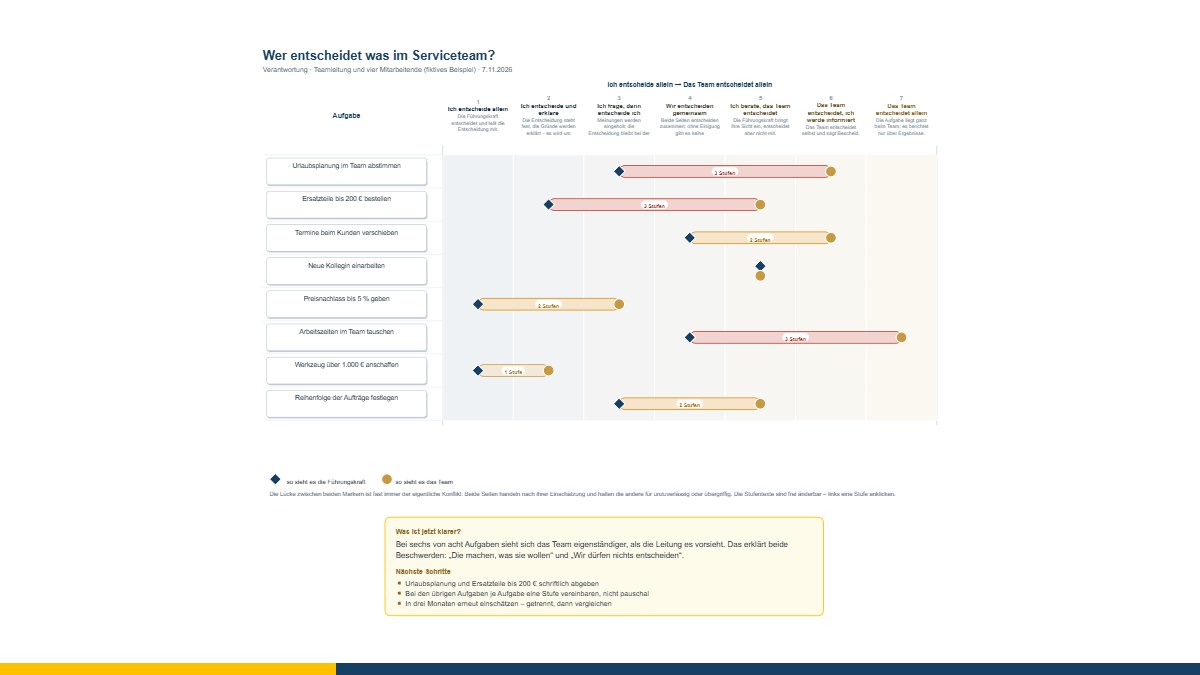
Two sentences I have heard in the same company on the same day: “They do what they like.” And two doors further along: “We are not allowed to decide anything here.” Both sides mean it seriously, both are right – and neither knows that the other places the very same task completely differently. That is exactly what the new tool responsibility and delegation is for.
Delegation does not fail because of ill will
It fails because both sides place the same task differently – and both act on their own assessment without noticing. The same situation then arises from two directions:
- The team sees itself as more independent (● to the right of ◆): it decides, and the management finds out afterwards. The management experiences people going it alone, the team experiences control.
- The team sees itself as less independent (● to the left of ◆): work is left undone or comes back although it had been handed over. The management experiences a lack of initiative, the team experiences a lack of backing.
In the built-in example – a service team with eight tasks – the team sees itself as more independent than the management intends for six out of eight tasks. That explains both complaints in one go. And it shows that nobody made a mistake here: everyone acted on their own assessment.
Seven stages – a starting point, not a law
The suggested stages are based on the leadership continuum by Robert Tannenbaum and Warren H. Schmidt (1958):
- I decide alone.
- I decide and explain.
- I ask, then I decide.
- We decide together.
- I advise, the team decides.
- The team decides, I am informed.
- The team decides alone.
These texts can all be changed, and I expressly recommend it: click a stage on the left and rewrite it in the language of your own organisation. Only then will the team recognise itself in it.
How to use it best
Two things decide whether the conversation achieves anything.
First: assess separately, then compare. If both sides sit in front of the screen together and move the markers together, what comes out is the polite middle and nothing else. Let each side assess on its own – or operate the tool yourself, but ask one after the other.
Second: concrete tasks. “Order spare parts up to €200” can be placed. “Purchasing” cannot. The more general the task, the more room for misunderstanding – and misunderstandings are exactly what you want to clear away.
Finally, every row needs an agreement: which stage applies in future, from when, and who tells whom. One task at a time. A blanket announcement covering all tasks does not last three weeks.
A note on the name
The tool is deliberately called “responsibility and delegation” and nothing else. There is a well-known card game with a similar structure from a different methodological background; this tool is independent of it, uses its own stage texts and names the leadership continuum by Tannenbaum and Schmidt as its source.
Your data stays with you
The tool transmits nothing; it saves as a file *.verantwortung.json. Merely opening the tool stores nothing in the browser. Exports: PDF, PowerPoint, LibreOffice Impress, Visio, SVG, PNG, a record with both views and the agreements, and CSV.
The assessments are points of view, not measurements – a reflection and conversation model, not a diagnostic instrument. Please also bear in mind: assessments about working with named people are personal data.
The tool is free of charge: open responsibility and delegation. If you would like to reorganise responsibility in your company, I am happy to support you – get in touch for a free initial consultation.
Open or download the tool
- Responsibility and delegation (seven stages)Open Download (462 KB)
Thinking further
You can find more on this topic under resources and downloads – or talk to me directly in a free initial consultation.
Comments
Comments are published immediately with your name. Only the name, title, comment text and time are stored – see the privacy policy.
Loading comments …