
This article was created with the AI assistant Claude and published by Peter Hoenig.
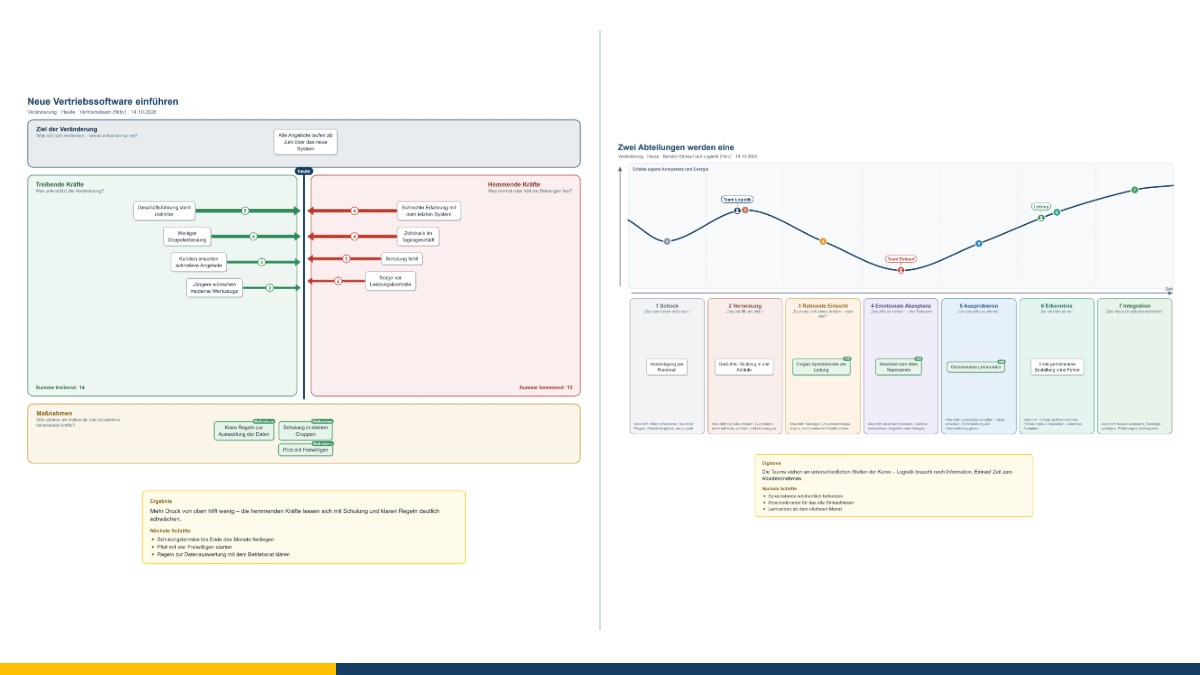
New software, a restructuring, two departments that are supposed to grow together: change in companies rarely fails because of the idea, but because of what holds it back – and because people experience it differently from what the plan envisages. Two proven models help to keep both in view: force field analysis for the forces acting on an initiative, and the change curve for the experience of those affected.
At a glance
- Force field analysis according to Kurt Lewin sets driving forces against restraining forces.
- It often helps more to weaken the restraining forces than simply to push harder.
- The change curve describes seven phases that people often go through during change – from shock to integration.
- Depending on the phase, different things help: information, listening, an opportunity to try things out.
- The free change editor contains both models.
Force field analysis
The psychologist Kurt Lewin, one of the founders of social psychology and of organisational development, regarded the current state as an equilibrium: forces pushing for change and forces holding it back keep each other in balance. If you want to change something, you can strengthen the driving forces – or weaken the restraining ones. Lewin pointed out that pure pressure often creates counter-pressure, whereas reducing resistance makes change easier. He is also the source of the well-known image of three phases: unfreezing, changing, refreezing.
How it works: name the goal, collect the driving and restraining forces, assess their strength and then ask: which restraining force can be weakened the most with reasonable effort? This gives rise to the actions.
The change curve
The change curve describes how people typically experience change: shock is followed by denial (“This doesn't affect us”), rational insight, emotional acceptance – often the low point – then trying out, realisation and finally integration. The curve shows the perceived personal competence and energy. It goes back to the phases that Elisabeth Kübler-Ross described in 1969 for coming to terms with loss, and it was developed further for change in organisations – in the German-speaking world by Richard K. Streich, among others.
What matters is that people go through the phases at different speeds and not always in this order. The curve is not a timetable but an invitation to look more closely – and to ask what people need right now. Those stuck in denial need reliable information; those in the valley of emotional acceptance need to be heard; those trying things out need room for mistakes.
Working with the change editor
- Force field analysis: the goal at the top, driving forces on the left, restraining forces on the right. The strength of each force (1 to 5) determines the length of its arrow; the forces line up one below the other and can be sorted by strength, and the totals appear at the bottom. Actions are collected underneath.
- Change curve: drag people or groups onto the curve – they snap into place, and the phase follows from their position. For each phase, enter observations and support; “What helps” offers suggestions.
- Several pictures: for example “Today” and “After the actions” or “A few weeks later”; the report shows the changes.
- Saving and export: save as a file, a printable report, export as PDF, PowerPoint, LibreOffice Impress, Visio, SVG, PNG and as a table for Excel.
The editor runs entirely in your browser and does not transmit any data. It is free of charge and available as free software under the GPL: Open the change editor in your browser.
Force field analysis and the change curve serve as models for reflection and dialogue, not as diagnostic instruments. Coaching is no substitute for psychotherapy.
Conclusion
Change succeeds better when you take the restraining forces seriously and meet people where they currently stand. If you are planning or supporting a change initiative, I will be glad to help you with business change management. Contact me for a free initial consultation.
Sources: Lewin, K. (1951): Field Theory in Social Science. New York: Harper. – Kübler-Ross, E. (1969): On Death and Dying. New York: Macmillan. – Streich, R. K. (1997): Veränderungsprozessmanagement. In: Reiß, M.; von Rosenstiel, L.; Lanz, A. (eds.): Change Management. Programme, Projekte und Prozesse. Stuttgart: Schäffer-Poeschel.
Thinking further
You can find more on this topic under resources and downloads – or talk to me directly in a free initial consultation.
Comments
Comments are published immediately with your name. Only the name, title, comment text and time are stored – see the privacy policy.
Loading comments …