
This article was created with the AI assistant Claude and published by Peter Hoenig.
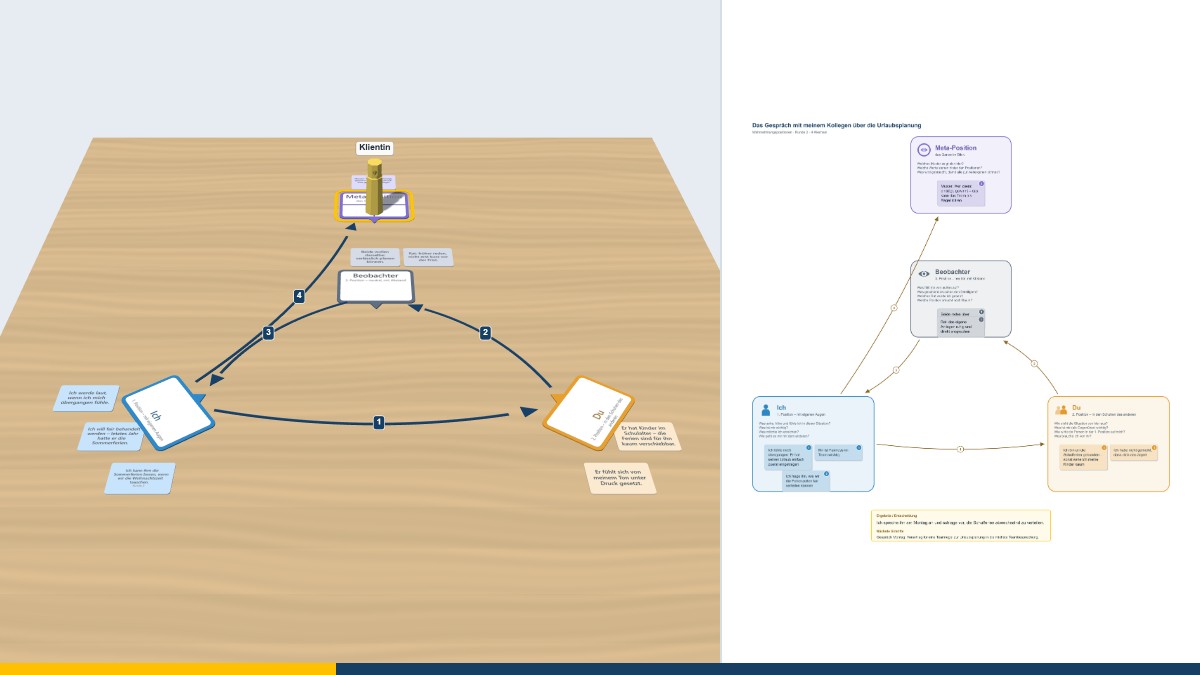
If you stand in a different place, you see things differently. Floor anchors make use of this simple experience: a sheet of paper on the floor stands for a point of view, a role or a time. Whoever steps onto it speaks only from that stance. The change of place creates distance from your own standpoint – and often surprisingly clear insights.
At a glance
- Floor anchors are marked places in the room that stand for a perspective.
- Well-known formats are the perceptual positions, the drama triangle, the tetralemma and the timeline.
- Moving between the positions is done deliberately; an observer position creates distance.
- The free floor anchor editor records positions, path and contributions on a board; the 3D version lets you walk the positions.
The aim of the method
In conversation, we usually stay within our own view. Floor anchors invite you to leave it for a while: What does the situation look like from the other person’s point of view? What does someone watching from outside see? What does my future self say about the decision I am making today? Because each position has a fixed place, the viewpoints do not get mixed up – and it becomes easier to say uncomfortable things, too.
Typical occasions are conflicts and difficult conversations, deadlocked decisions, recurring patterns in relationships and planning goals along a timeline.
Formats and where they come from
Perceptual positions: the first position is your own view (“I”), the second that of the other person (“you”), the third that of a neutral observer. Often a meta position is added that looks at everything that is going on. The format was described by John Grinder and Judith DeLozier in the context of neuro-linguistic programming.
Drama triangle: in 1968, Stephen Karpman described in transactional analysis three roles that people slip into in deadlocked conflicts: persecutor, victim and rescuer. Stepping into the roles one after another makes the pattern visible – and from an additional position you can consider what a way out might look like.
Tetralemma: Matthias Varga von Kibéd and Insa Sparrer transferred this figure of thought from Indian logic to systemic constellation work: the one, the other, both, neither – and a fifth position that leaves even this order behind. You can read more about it in the post Deciding with the tetralemma and the decision balance.
Timeline: past, present and future lie on a line on the floor. Standing at one point on the line, you can look back and ahead. Timeline work is a widespread format, also with roots in NLP.
How to work with floor anchors
- Clarify the concern and choose a suitable format.
- Mark the positions – in the room with sheets of paper, digitally on the board.
- Step into a position and speak from that stance; guiding questions help.
- Before each change, step briefly into the observer position: What has emerged so far?
- Continue with further rounds until things become clearer.
- Record the result and next steps.
Working with the floor anchor editor
- Formats: perceptual positions, drama triangle, tetralemma in the room, timeline on the floor or positions of your own. Positions from other formats can be added; when you switch format, the notes are kept.
- Stepping into positions: a click on a position makes it active; guiding questions appear and, if you wish, a time limit runs.
- Contributions: notes go into the current position. Every change is recorded as a numbered arrow; returning to the starting position begins a new round.
- Record and export: concern, picture, contributions per position and round, path and result as a printable record; export as PDF, PowerPoint, LibreOffice Impress, Visio, SVG, PNG and as a table for Excel.
The editor runs entirely in your browser and does not transmit any data. It is free of charge and available as free software under the GPL: Open the floor anchor editor in your browser.
Floor anchors in 3D
In a face-to-face session, clients actually walk from sheet to sheet. Over video, this movement is missing – and this is where the 3D floor anchor tool comes in. The positions lie as sheets on a table or floor, a figure walks them one after the other, and the path appears as numbered arrows. From each position you can look into the room: just as you would if you were standing there, looking towards the other positions. The tip of the floor anchor shows the direction of view and can be rotated.
Notes lie as cards next to their position, and people and symbols can be added. The result and next steps appear on the printable picture sheet. Files can be transferred in both directions between the board and the 3D version: Open the 3D floor anchors in your browser.
In coaching, floor anchors serve as a model for reflection and dialogue, not as a diagnostic instrument. Coaching does not replace psychotherapy.
Conclusion
A step to the side can achieve more than an hour of thinking in the same place. If you would like to look at a conflict, a decision or a goal from several perspectives, I will be glad to support you through Personal Coaching or Business Coaching. Get in touch for a free initial consultation.
Sources: Grinder, J.; DeLozier, J. (1987): Turtles All the Way Down. Prerequisites to Personal Genius. Scotts Valley: Grinder, DeLozier & Associates. – Karpman, S. B. (1968): Fairy Tales and Script Drama Analysis. Transactional Analysis Bulletin 7 (26), pp. 39–43. – Varga von Kibéd, M.; Sparrer, I. (2000): Ganz im Gegenteil. Tetralemmaarbeit und andere Grundformen Systemischer Strukturaufstellungen. Heidelberg: Carl-Auer.
Thinking further
You can find more on this topic under resources and downloads – or talk to me directly in a free initial consultation.
Comments
Comments are published immediately with your name. Only the name, title, comment text and time are stored – see the privacy policy.
Loading comments …