
This article was created with the AI assistant Claude and published by Peter Hoenig.
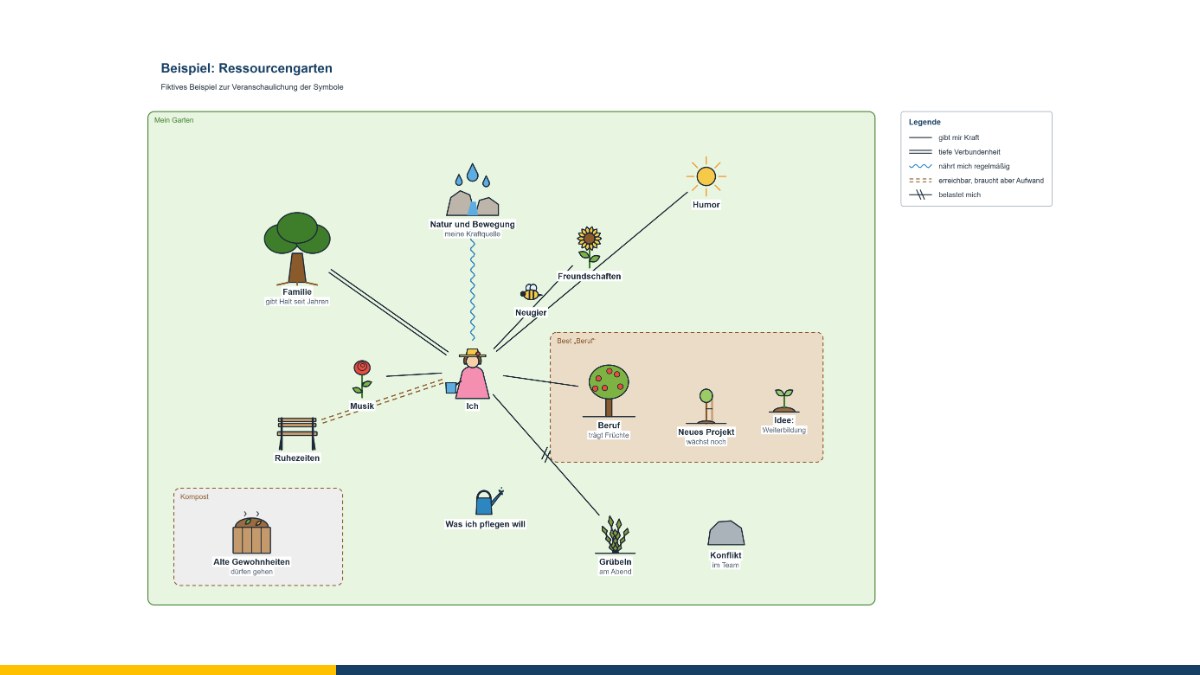
What gives you strength? The question sounds simple – and yet it is often hard to answer, especially in demanding times. The resource garden uses an image that almost everyone understands: a garden needs care; some things grow by themselves, others need watering, protecting or occasionally cutting back. This makes it easy to picture your own sources of strength and to talk about them.
At a glance
- The resource garden makes personal sources of strength and burdens visible as a garden.
- It belongs to the resource-oriented methods; there is no single originator.
- You decide for yourself what the symbols mean.
- With the free editor, the garden takes shape directly in your browser.
Aim of the method
Resources are everything that helps a person cope with demands: abilities, experience, relationships, values, health, places, rituals. In everyday life, they easily slip out of view. The resource garden invites you to collect and arrange them: What is growing strongly? What is in bloom right now? Where is a spring I can draw from? What needs care – and what is taking the light from other plants?
Especially in coaching on stress, change or new tasks, the garden helps to shift the focus from the problem to what is already holding you up.
Where the method comes from
The resource garden is not a method with a single inventor. It stands in the tradition of resource orientation, which has spread in counselling and therapy since the 1970s and 1980s. Important roots are Aaron Antonovsky's model of salutogenesis, which asks what keeps people healthy, the solution-focused brief therapy of Steve de Shazer and Insoo Kim Berg, and Klaus Grawe's research on resource activation. Images and metaphors such as the garden make this attitude tangible in conversation.
How to lay out the resource garden
- Place yourself in the garden as the gardener.
- Add resources as plants: stable resources as trees, for example, joy as flowers, sources of strength as a fountain or pond, successes as fruit.
- Also show what is a burden or needs care – such as weeds, drought or a damaged fence.
- Draw in paths, boundaries and supply: What is connected with what? Where is protection needed?
- Look at it together: What stands out? What would you like to tend more? Which small piece of gardening would be a first step?
Working with the editor
- Symbols: 94 dedicated, coloured symbols in ten groups – people, trees, flowers, water, fruit, tools, burdens and more – with a search function. In colour or in black and white, as you prefer.
- Connections: connection, strong connection, supply, path, boundary (as a fence) and troubled connection.
- Areas: meadow, flower bed, water, gravel and more, for shaping areas of the garden.
- Saving and export: save as a file, export as PDF, PowerPoint, LibreOffice Impress, Visio, SVG and PNG.
The editor runs entirely in your browser and does not transmit any data. It is free of charge and available as free software under the GPL: Open the resource garden editor in your browser.
The resource garden serves as a model for reflection and dialogue, not as a diagnostic instrument. Coaching is not a substitute for psychotherapy.
Conclusion
A garden shows at a glance what is growing and what needs care. If you would like to lay out your resource garden together with me, get in touch for a free initial consultation.
Sources: Antonovsky, A. (1979): Health, Stress, and Coping. San Francisco: Jossey-Bass. – de Shazer, S. (1985): Keys to Solution in Brief Therapy. New York: Norton. – Grawe, K. (1998): Psychologische Therapie (Psychological therapy). Göttingen: Hogrefe.
Thinking further
You can find more on this topic under resources and downloads – or talk to me directly in a free initial consultation.