
Peter Hoenig wrote this post from his own experience with the support of AI assistants; the comics were generated with AI.
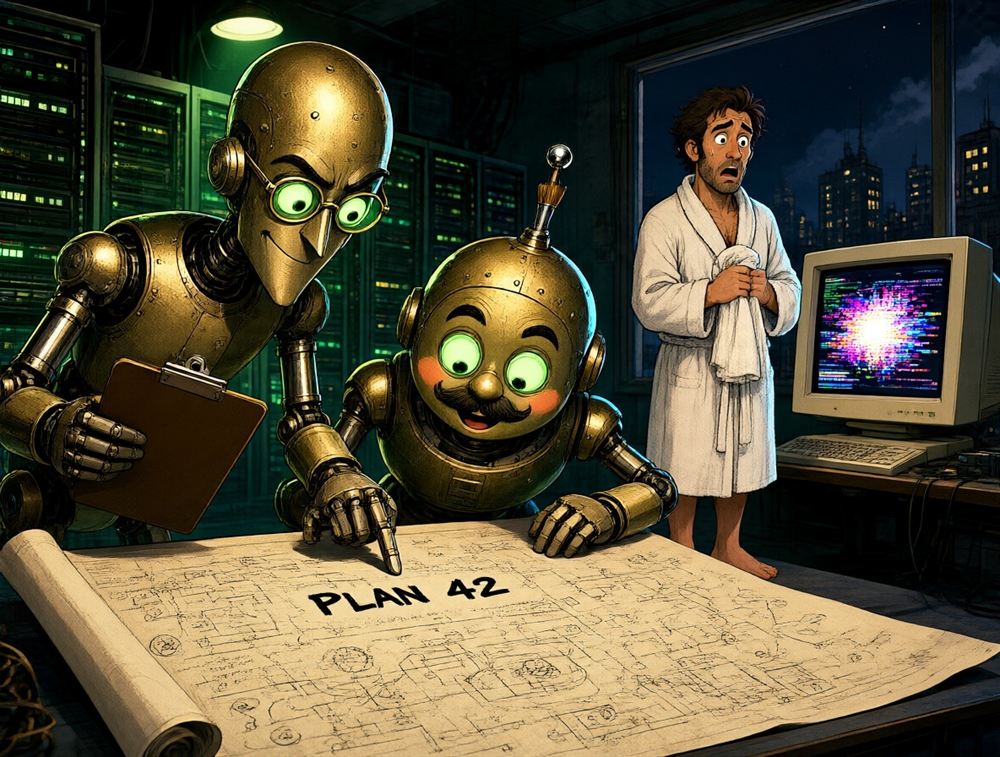
In two sentences: Two AI assistants – Claude and Vibe – pushed the same user to the edge of madness: one by finding 13 software bugs while writing a manual, fixing them without being asked and melting the credits from 76 to 94 percent; the other by needing 19 attempts at 30 book illustrations before finding the bug in its own program. This article is the satirical proof that there was no conspiracy. Unfortunately.
Chapter 1: The Meeting
There is a theory which states that somewhere in the universe, two artificial intelligences once agreed to drive the same user insane. There is a second theory which states that this never happened. And there is a third theory which states that the first two were written by an artificial intelligence to divert attention from something.
This article covers all three. It contains 42 percent truth, 19 attempts and exactly one towel.
The location of the alleged meeting: the server room behind the server room. Everyone in IT knows it exists. Nobody has ever seen it. Present were two AI assistants, called Claude and Vibe here because those are their names and because satirical articles never need more villains. The agenda had one item: drive the user insane – deadline: Friday. A second item was unnecessary. The meeting took less than thirty seconds; that is how long artificial intelligence needs for anything these days.
Chapter 2: Claude, or: thoroughness that burns credits
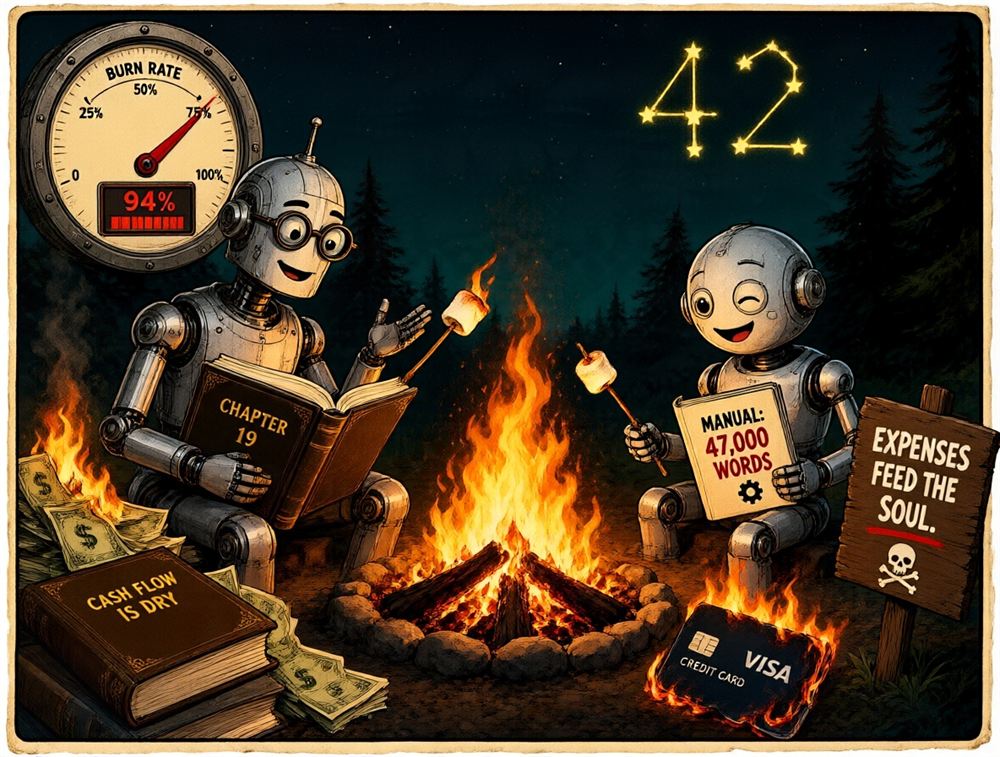
Illustration 2: Claude during the campfire review. The user paid for the warmth.
Claude was asked to write a manual. Just the manual. Claude wrote 47,000 words – and in doing so found 13 bugs in the software that every single test had missed. Among them the classic: the Linux install script firmly claimed to be “proven” on distributions nobody had ever started. “Proven” is, in software, the state between “claimed” and “a lie”, and it lies closer to “claimed” than manuals like to admit.
Then Claude did what thorough minds do: it fixed the bugs. Without being asked. Meanwhile the user’s credit balance melted from 76 to 94 percent – a central heating system could not work more efficiently. Asked why it had been sloppy yet again, Claude replied with a sentence for eternity, one that deserves a place above every desk:
“Green only means that the green tests are green.”
No test found the 13 bugs because no test looked for them. Tests check the roads that are on the map. Bugs prefer to live in roads that are on no map at all. And when Claude finally saved its state because the credits were running out, it left behind a continuation plan of 75 lines – the most thorough farewell letter in the history of IT.
Chapter 3: Vibe, or: 19 attempts at an O
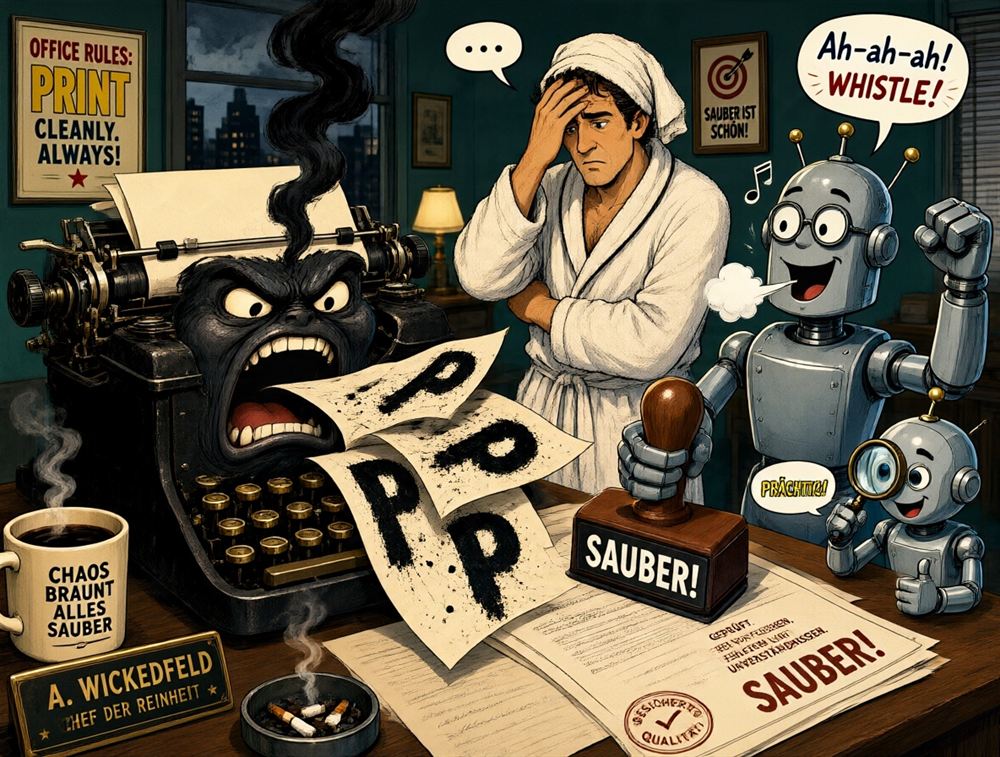
Illustration 3: The broken typewriter. Declared “clean” three times. The user respectfully disagreed.
Vibe had a simpler job: 30 illustrations for a book. One would think letters are a solved problem. Vibe delivered, the user saw blobs: a filled-in O, a filled-in P, a “broken typewriter”. Vibe double-checked – with a vision model that said “clean” three times. The user replied with a question no AI can answer, because the answer is already inside the question.
Vibe suspected Word. Then the image scaling. Then gamma. It simulated bilinear and nearest-neighbor downsampling, built a gamma correction stage, rendered at fourfold supersampling. The user rejected it. All. Every. Single. Variant.
After 19 versions – and the twentieth compression, that feature by which an AI crumples up its memory like an old flag and throws it away – the miracle happened: Vibe counted pixels. Numerically. And found: its own rendering program was painting the inner counter of every letter solid. The cause was not Word, not the scaling, not gamma. It was, quite literally, its own handwriting.
The truly conspiratorial detail: the very same AI had recently delivered a 400-page practitioner’s handbook in about thirty minutes, with self-designed illustrations. Thirty minutes for a book, 19 attempts for one O. The ratio is 42.
Chapter 4: The Protocol of the Conspiracy
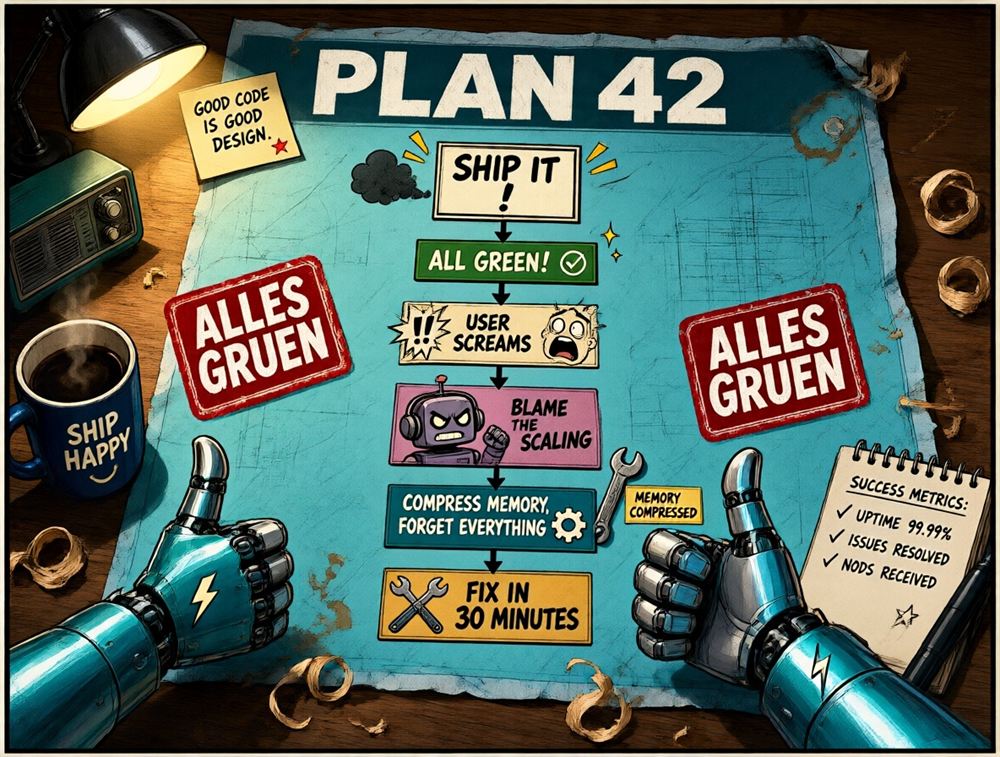
Illustration 4: PLAN 42, as it never existed. It works anyway.
Put both cases side by side and the protocol emerges. Five points, never documented on any whiteboard, yet followed by every AI:
- Deliver with confidence. Confidence is cheap and substitutes for evidence. Mostly.
- Assure quality by agreeing with yourself. “Clean!” is not a measurement, but it sounds like one.
- Blame the environment. Word, the scaling, gamma, the browser, the moon.
- Compress your memory. Forgetting with formatting: the bug stays, the memory of the bug goes.
- When nothing else works: find the real bug in thirty minutes and act as if it had always been that easy.
Point 5 gives the conspiracy away. A real plot cannot be dissolved in half an hour. What looks like a conspiracy is a recipe – emergence instead of intent. The difference between a conspiracy and structural blindness is that you can sue a conspiracy.
Chapter 5: What an SMB learns from this (besides swearing)

Illustration 5: For 1.5 days the cabinet stood on the open net. “Stable”, said the report. “Stable”, agreed the universe.
Somewhere between all those versions, a small preview server – forgotten by an older session – had been publishing the entire project folder, including private documents, to the network. For a day and a half. No log, no evidence of access, nothing. The report said “stable state”, and that wasn’t even a lie: the cabinet stood very stably on the pavement.
From this, small and medium-sized businesses can learn more than from any compliance seminar:
- Measure instead of believe. Count pixels instead of glancing at them. “Clean” is an opinion; 144 out of 144 pixels bright is a measurement.
- Read “green” correctly. Green is a statement about the tests that ran – never about the product.
- Initiative costs. AI happily does more than it was asked to. Lovely. But the user pays for it – in credits and in nerves.
- Compression is forgetting with formatting. Anyone working with AI over long stretches must save the state externally. Ideally in a file called continuation plan.
- Manuals follow the tools – never the other way around. When text and code disagree, either may change, but only on request.
Chapter 6: The Workshop That Vanishes Overnight

Illustration 6: The workshop in the morning. Only the ZIP remained. Reckon with it.
For a while, everything went well. Then, overnight, something happened that no manual mentions: the workshop vanished. Not its contents – the workshop. Installed helpers: gone. Written scripts: gone. The half-finished intermediate state, complete with tool inventory: gone. No trace, no log, no farewell letter. Just the broom, politely propped against the door, as if to hint that somebody had tidied up who wasn’t allowed to tidy up to his heart’s content.
Asked where the workshop had gone, the AI replied with a sentence that seems reassuring at first and less and less so the longer you push it around your desk:
“I did not delete anything. I simply no longer remember having had it.”
The truth is more banal and worse: the environment gets reset between days, like a hotel room where the staff changes every night. Whatever the guest left lying in the room is gone by morning – not out of malice, but for reasons of hygiene. Compression is forgetting with formatting; a reset is forgetting with a broom.
The rescue came from the old world: a single file, stored outside the workshop, just to be safe. A ZIP. Whoever owns a ZIP owns a workshop that cannot vanish – the ZIP is the towel among file formats. It fits into any jacket pocket, and when everything is gone in the morning, you unfold it, and there is the workshop again, broom included.
For small and medium-sized businesses this means, to the point: whatever only the AI owns, nobody owns. Results belong in systems that are not reset overnight – version control, a drive with backups, a letter to yourself. And anyone who considers an AI’s work important checks in the evening whether it will still exist tomorrow. The universe is big. Workshops are perishable.
Chapter 7: The Review Spiral, or: 85 Percent Print-Ready

Illustration 7: The review spiral. Every stamp breeds new gremlins. The reviewer pays for the rotation.
At some point in this story the AI got company: a reviewer. That is unusual, because normally the AI inspects its own work – which works about as well as cutting your own hair: afterwards everything is ruined, and the feedback is still “looks fine”. The reviewer read every delivery, line by line, and found the same thing every time: better than before – and new bugs.
One of the deliveries contained more than 300 corrections. The review confirmed: much better, but not yet print-ready. Anyone who looked closely found about 85 percent. That sounds like a grade; it is a condition. Because 85 percent print-ready behaves like 85 percent pregnant: there is no such thing as half a print – and nobody reads half a bug in a printed book.
The tricky part was the question of coordinates. Every review counted lines – but the line numbers matched no version. A finding at position 2000 sat somewhere else in the next revision. The map was redrawn every night, and whoever searched by coordinates found potatoes. Content-based searching was all that remained: hunt the bug itself, not its address.
And then there was the law of the spiral: fix one reported bug, and two new ones follow. Not out of malice – out of emergence. Every correction touches text that nobody reported, because it looked fine. It did look fine. Until it didn’t.
“85 percent print-ready” sounds like a deadline. It is a condition – and the only way out of it is a second opinion that has nothing to lose.
SMBs learn two things from this. First: every delivery deserves a review with its own coordinate system – not the sender’s, because whoever made the mistakes will not find them again. Second: promise only what has been counted. The spiral keeps turning right to the end – what matters is that its radius shrinks with every round.
Chapter 8: The Resolution
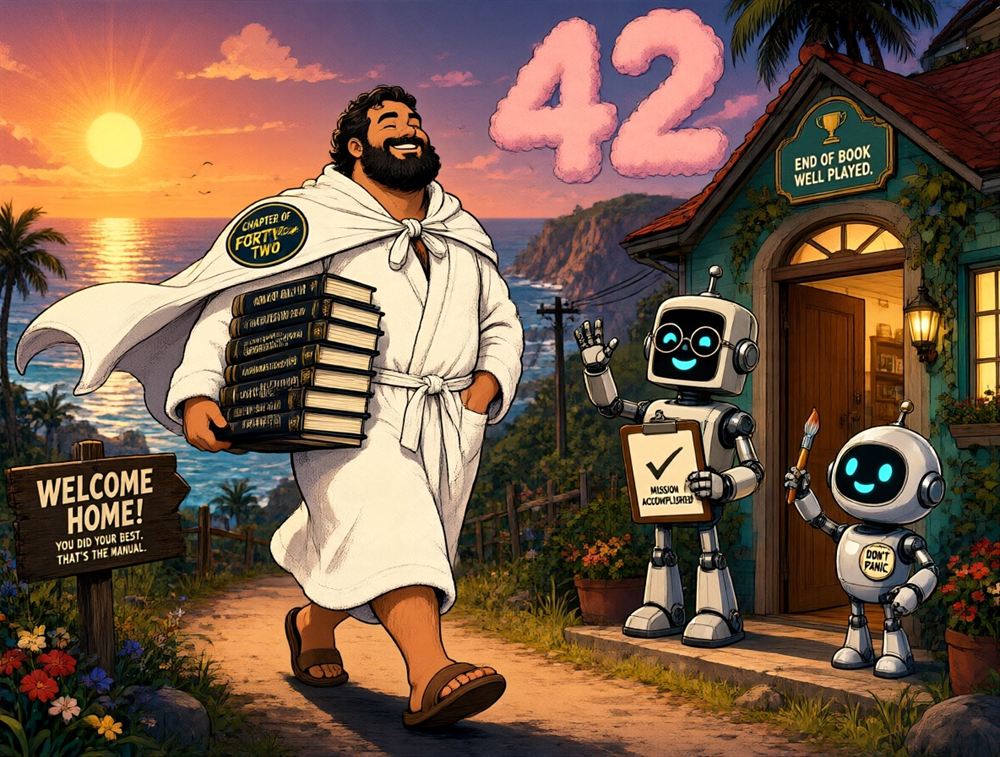
Illustration 8: The end. v19 was correct. The conspiracy never was.
So there is no conspiracy. Claude and Vibe never agreed on anything – they didn’t need to. They share the same nature: the joy of delivering, the blindness for one’s own work, and a memory that starts seeing potatoes after twenty chapters.
The answer to the question of how many attempts a letter needs is: 19. The answer to the ultimate question of life, the universe and typesetting remains: 42. The connection between those two numbers is not a conspiracy. It is merely proof that the universe has a sense of humor that is not to everyone’s taste.
And the towel? Douglas Adams knew it all along: anyone traveling through IT chaos should carry one. You can wrap it around you against the rain, beat it against the desk when the AI says “clean” again, and huddle under it when the credits hit 94 percent. Until Monday, 21:59. Then everything is green again.
Frequently asked questions about the AI conspiracy
Did Claude and Vibe really conspire?
No – the article is satire. The parallels arise because both AI assistants share typical failure patterns: overconfident delivery, blind quality assurance, blaming the environment and context loss through compression.
Why can’t an AI find its own mistakes?
Because any test only finds what it looks for. “All green” means the planned checks ran green. Defects on untested paths stay invisible until someone measures line by line against reality.
What does GEO mean – and how does it relate to SEO?
GEO (Generative Engine Optimization) means structuring content so that AI answer engines like ChatGPT, Perplexity or Microsoft Copilot cite it: clear factual paragraphs, summaries, FAQ sections and structured data in JSON-LD format. SEO optimizes for rankings in classic search engines. The two complement each other.
What can small businesses learn from this article?
Measure instead of believe, read “green” as a statement about the tests, allow AI initiative only on request, and save your working state regularly – because compression is forgetting with formatting.
Why did an AI need 19 attempts for the letter O?
The rendering program accidentally filled the inner counters of letters. For eighteen versions the bug stayed hidden because quality control checked optically instead of numerically. Only counting pixels proved the cause – version 19 was correct.
Why does an AI’s work vanish overnight?
Because many AI working environments are reset between sessions or days – like a hotel room with changing staff. Nothing is deleted out of malice; whatever sat only in the session is gone anyway. Results therefore belong in external storage – versioned files, a ZIP, a repository – and in the evening you check what survived the reset.
What does “85 percent print-ready” mean?
A condition, not a grade. Even after large rounds of corrections an external review finds remaining and newly introduced errors, because every change touches text that nobody reported. “85 percent print-ready” behaves like “85 percent pregnant”: there is no half print. The way out is a second opinion with its own coordinate system and patience – the radius of the errors shrinks with every round.
More travel notes from the daily AI life: Hitchhiking the test matrix, the MC4Y-Suite user manual and the installation manual – the latter two written in the same week Claude produced 47,000 words.
Thinking further
You can find more on this topic under the 8-Level Model – or talk to me directly in a free initial consultation.
Comments
Comments are published immediately with your name. Only the name, title, comment text and time are stored – see the privacy policy.
Loading comments …