
This article was created with the AI assistant Claude and published by Peter Hoenig.
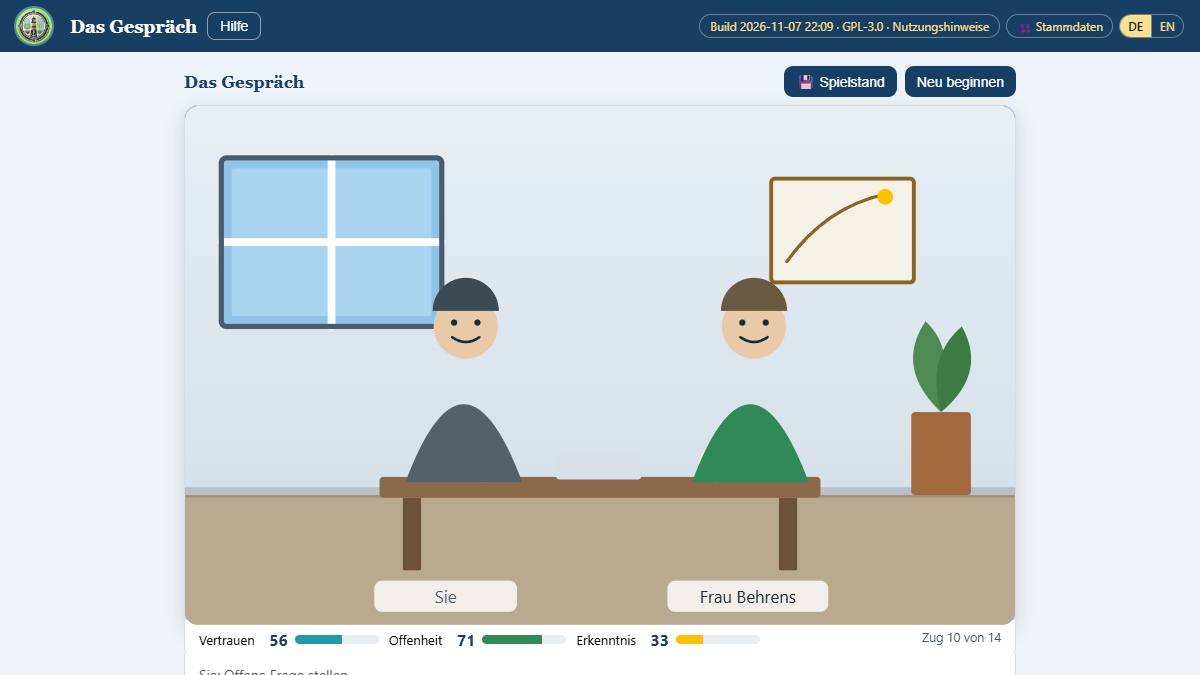
Conversational skills are hard to learn from a book, because what matters is not in the sentence but in the moment. So here is The Conversation: fourteen moves, six options per move, and three quantities running visibly alongside – trust, openness, insight. In your browser, free of charge, with nothing transmitted.
"Advice is a blow"
The German saying – Ratschläge sind Schläge – is old and easily dismissed as a pun. In the game it is a number. Every piece of advice you give lowers your counterpart's openness, regardless of how good it is, and most strongly in the first moves. The reason is not that advice is bad. The reason is that advice turns a conversation into an enquiry: from then on, one of you is the expert and the other is the case.
Try playing fourteen moves using nothing but advice. The result is called "Polite and without a result", and openness ends at zero. It is the most instructive game of them all, and it takes two minutes.
The hardest move is silence
Silence produces the greatest gain in insight in the game – but only if your counterpart has just said something essential. Used at random, the same pause feels awkward and costs trust. How do you recognise the moment? By the fact that your counterpart talks about themselves instead of merely answering: the sentence gets longer, more personal, and often ends unfinished.
This is the only point where the game asks something of you that cannot be calculated. You have to listen. And: it does not work twice in a row – the moment has been used, and you have to let the next one emerge.
Confronting, rightly and wrongly
Confronting is the strongest tool in the game and the most dangerous. If trust is sufficient, you get the breakthrough: your counterpart says the sentence the whole conversation was about. If it is not, the conversation closes – politely, courteously and finally. There is no way to recover it within the same conversation.
That is exactly how it works in practice. Which is why the order is: first make it strong enough, then say it.
Three conversation partners
The sceptic was sent to the conversation rather than asked. Her trust starts very low, advice works particularly badly on her, and it is a long way to a confrontation. The talker fills every pause himself – silence works differently here, sometimes even without the right moment. The quiet one lets open questions run dry; here reflecting and silence are what carry.
There is no strategy that works on all three. That is deliberate.
What this game is not
It is a learning game for conversational skills – not a therapy simulator and not a diagnostic instrument. The characters and their concerns are invented and deliberately kept to work situations: overload, a conflict with a colleague, dissatisfaction with one's own role. And the note that belongs on all my tools: coaching is not psychotherapy (§ 1 (3) of the German Psychotherapists Act).
In short
Free as free software, independently implemented: Open The Conversation. At the end, the evaluation shows each of your fourteen moves with its effect – and marks the move at which the conversation tipped over. If you want to work on your conversational skills, ideally with real concerns rather than invented ones: free initial consultation or personal coaching.
The conversation partners, their concerns and all texts are invented. The game is a practice and reflection model and does not replace psychotherapeutic, medical or other professional advice.
Open or download the tool
- Das Gespräch (Lernspiel)Open Download (301 KB)
Thinking further
You can find more on this topic under Ressourcen und Downloads – or talk to me directly in a free initial consultation.