
This article was created with the AI assistant Claude and published by Peter Hoenig.
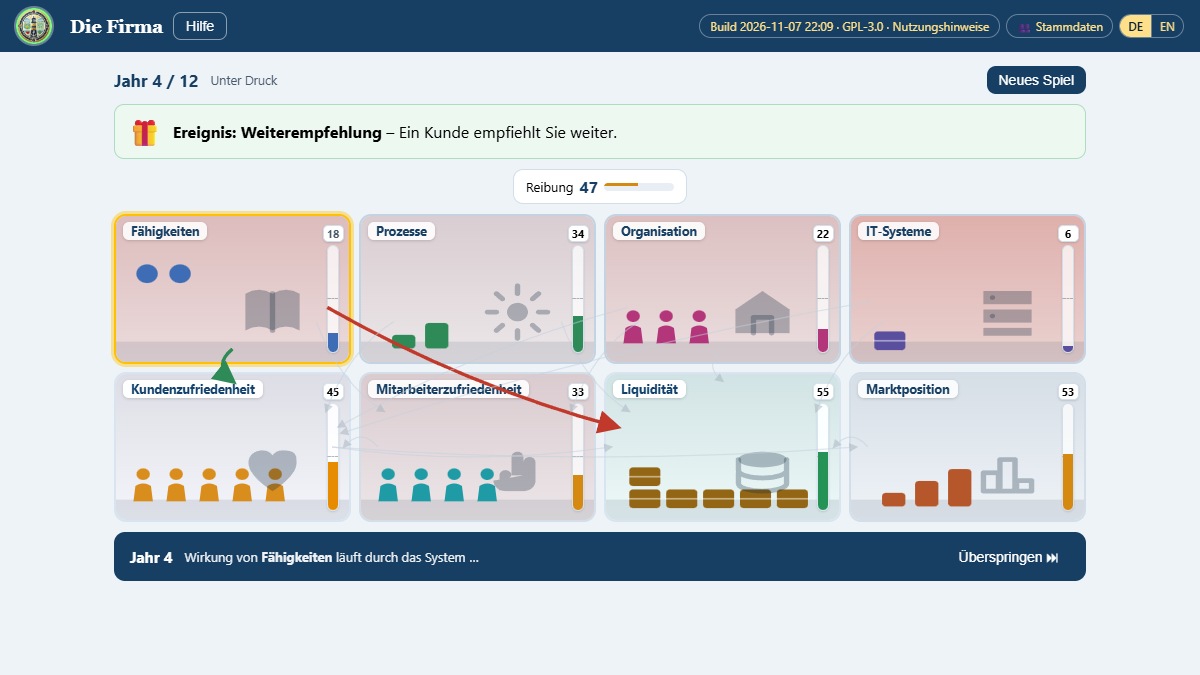
A model on a slide is something you can look at. A model that argues with you for twelve years is something you understand. That is why the 8-level model now exists as a game: The Company. You lead a small business through twelve years and allocate your budget across the four lower levels – capabilities, processes, organisation, and tools and IT systems. It runs in your browser, costs nothing and transmits nothing.
How to play
Each year you distribute your budget across the four levels with + and –; the sum must not exceed your budget, and a lever can only be moved by a limited amount per year. The game then works the year out, and it does so visibly: arrows show one after another which effect is currently running through the system, green for reinforcing, red for dampening. An adviser then comments on the situation, and history curves show how everything has developed.
The interesting part is what you do not see straight away. Investing in capabilities costs money today and pays out in two years, in customers and in people. Cutting the IT budget saves money today – and raises a quantity that is not even displayed to you at first.
Why the obvious strategy fails
The obvious strategy for a business owner under pressure is to protect the cash. In the game that works beautifully for three years: liquidity rises and everything feels relaxed. Then customer satisfaction slips, the market position follows two years later, and with it the revenue disappears. In the end the cash is gone – not despite the saving, but because of it.
The second most obvious strategy is to serve all four levels evenly. That sounds sensible, feels fair, and is the most expensive variant of all: you pay for everything and get enough of nothing. Because every lever has a threshold – below it, almost nothing happens. Half a process initiative is not half an improvement, it is no improvement. In the game, even distribution therefore ends up clearly behind any pair that serves two levels properly.
The opposite fails too, though. Putting everything into a single level runs into two limits: a level can only absorb so much in one year – anything beyond that is wasted – and extremely well qualified people achieve very little inside poor processes, unclear responsibilities and outdated tools. The more unbalanced the levels are, the weaker every single investment becomes. The weakest level limits the others – the central statement of the 8-level model, and in the game you notice it in points rather than in sentences.
What works are pairs. Capabilities and IT systems together: ability and tooling. Or processes and organisation together: workflow and responsibility – because a process without clarified ownership never lands. Which pair is the right one depends on the starting situation, and that is the real decision in this game.
What you see at the end
After twelve years the game adds everything up: customers, people, market, cash and friction. Next to it stands a separate line that matters more to me than the total score – "Does it serve people?", made up of customer and employee satisfaction. And below that you see how you distributed your budget across the four levels on average. Distribution and result side by side: that is the real evaluation.
Who is this for?
For managing directors of small and medium-sized companies who would like to try out, without any risk, what a decade of their investment decisions actually does. For workshops: anyone who has played "The Company" no longer needs an introduction to the 8-level model – they have experienced it. And for everyone who wants to know why the same problems keep coming back in their organisation even though everybody works hard.
In short
A game that invites you to pause rather than to rush – an independent implementation, free as free software: Open The Company. More about the model behind it is on the page The 8-level model; how networked thinking works at all I explain with no prior knowledge in Networked thinking – why simple cause and effect often leads you astray. If you want to understand your company as a system and shape it so that it serves people, do get in touch for a free initial consultation.
"The Company" is a simplified learning and thought model, not a forecasting tool and not a business valuation.
Open or download the tool
- Die Firma (Simulationsspiel)Open Download (325 KB)
Thinking further
You can find more on this topic under Ressourcen und Downloads – or talk to me directly in a free initial consultation.