
This article was created with the AI assistant Claude and published by Peter Hoenig.
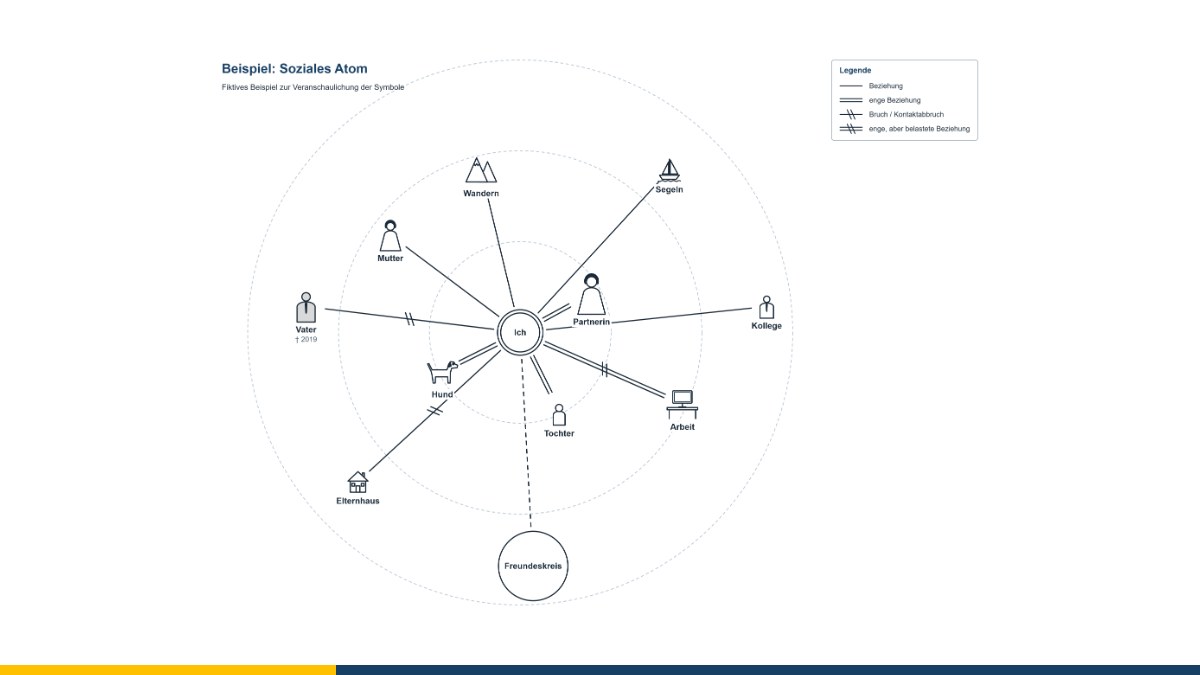
Every person is embedded in a network of relationships: family, friends, colleagues, but also pets, hobbies or work itself. The social atom makes visible how this network is experienced personally – who is close, who is distant, which relationships are supportive and which are a burden. I described the method itself in an earlier post on the social atom; here the focus is mainly on working with the editor.
At a glance
- The social atom shows the web of relationships as a person subjectively experiences it.
- It goes back to Jacob Levy Moreno, the founder of psychodrama and sociometry.
- Closeness and distance, as well as the type and strength of relationships, are represented spatially.
- The free editor creates the social atom directly in your browser.
Aim of the method
The point is not to draw a “correct” picture of your relationships, but to make your own experience visible. Simply drawing it raises questions: Whom do I place close to me, whom further away? Who is missing? Which relationships give me strength, which drain it? Where would I like more closeness – and where more distance?
In coaching, the social atom helps, for example, with career changes, in conflicts or when someone wants to see who can support them in a project.
Where the method comes from
Jacob Levy Moreno (1889–1974), physician and founder of psychodrama and sociometry, described the individual in the 1930s as part of a “social atom”: the smallest unit of relationships a person needs in order to live. In his work “Who Shall Survive?” (1934), he laid the foundations of sociometry, the study of relationships in groups. The social atom is still used today in psychodrama, counselling, supervision and coaching.
How to create the social atom
- Place a symbol for yourself in the centre.
- One by one, add the important people and areas of life as symbols – close or distant, large or small, as feels right.
- Represent the relationships with lines, for example their strength or whether they are strained.
- Look at the picture together: What stands out? In what order were the symbols placed? Who stands where – and what would change if something moved?
Working with the editor
- Symbols: 20 symbols for people, animals and areas of life. Men and women can be shown either as pictograms or with Moreno's classic symbols (triangle and circle).
- Circles of closeness: Concentric circles around “Me” help you to gauge closeness and distance.
- Lines: four types of line whose meaning you define yourself – they appear in a legend.
- Saving and export: Save as a file on your computer, export as PDF, PowerPoint, LibreOffice Impress, Visio, SVG and PNG.
The editor runs entirely in your browser and does not transmit any data. It is free of charge and available as free software under the GPL.
In coaching, the social atom serves as a model for reflection and dialogue, not as a diagnostic instrument. Coaching does not replace psychotherapy.
Conclusion
The social atom is a simple yet often surprisingly revealing method. You will find the editor on the page Editor for the social atom. If you would like to use the method in coaching, get in touch for a free initial consultation.
Source: Moreno, J. L. (1934): Who Shall Survive? A New Approach to the Problem of Human Interrelations. Washington: Nervous and Mental Disease Publishing.
Thinking further
You can find more on this topic under resources and downloads – or talk to me directly in a free initial consultation.