
This article was created with the AI assistant Claude and published by Peter Hoenig.
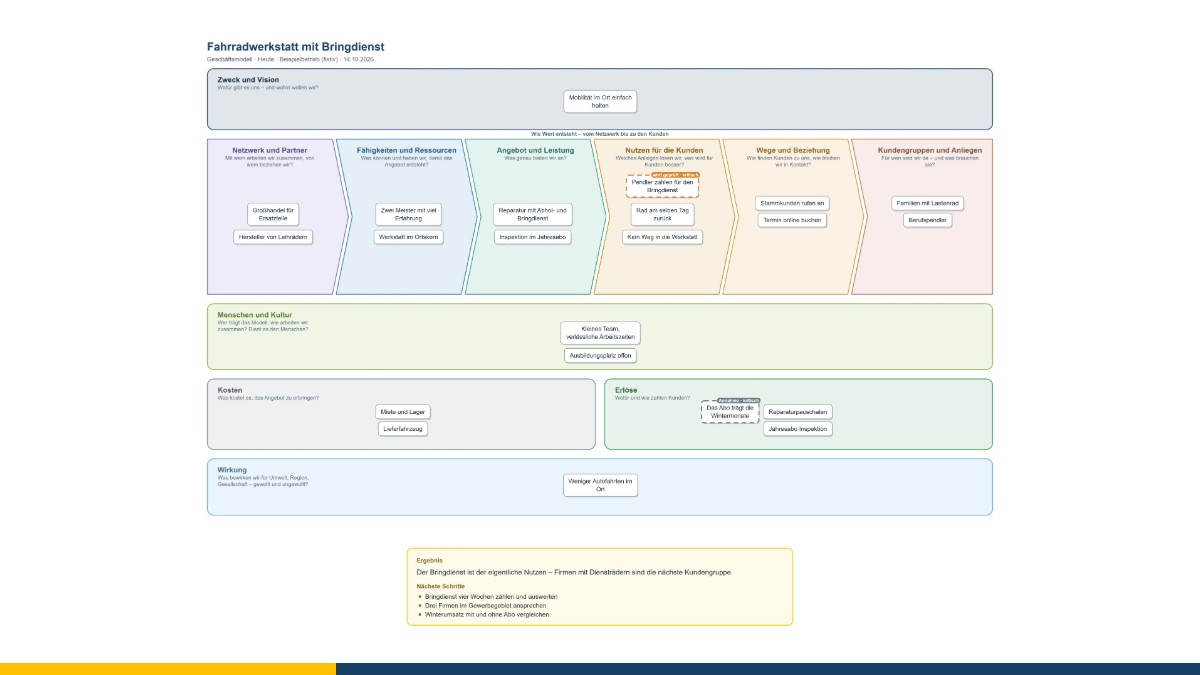
A business model describes how a company creates value, delivers it and makes its living from it. That sounds like something for large corporations – but it applies to every trade business, every practice and every self-employed person. If you can describe your business model on a single page, you understand better where it holds up, where it wobbles and where change should start. My business model board arranges the usual questions as a flow of value – and explicitly puts people in the picture, too.
At a glance
- A business model answers these questions: Why do we exist, for whom, what do we offer, how is benefit created, and what do we live on?
- The business model board shows this as a flow of value from the network to the customer groups.
- Purpose, people and culture, and the impact on the environment and society are part of it.
- Uncertain points are recorded as assumptions and tested.
- The board is free of charge and an original design by MY COACHING FOR YOU.
The aim of the method
Many companies know their offerings precisely, but are less clear about the benefit their customers see in them. Others know what they are good at, but not which customer group needs it most. The board makes these connections visible: Which partners and capabilities support the offering? What benefit results from it, and by which routes does it reach which customers? What does it cost, what does it bring in – and what effect does it have beyond that?
Looking at the assumptions is particularly valuable: much of a business model is conjecture – that customers will pay for a delivery service, or that a subscription will carry the winter business. If you name these assumptions and test them in a targeted way, you avoid costly mistakes.
Where the method comes from
Describing business models on a single page has become widespread since the 2000s. Particularly well known is the Business Model Canvas by Alexander Osterwalder and Yves Pigneur (2010) with nine building blocks. The University of St. Gallen developed the Business Model Navigator, which describes a business model by means of four questions: Who are the customers, what is offered, how is it produced, and how is value created?
My business model board takes up the questions that are generally asked, but arranges them differently: as a chain of arrows in which value flows from the network via capabilities, offering and benefit to the customers. In addition, there is the company’s purpose at the top and people and culture below – with the guiding question of my 8-Level Model: Does it serve people? – as well as the impact on the environment, the region and society. It is not a copy of the Business Model Canvas and is not affiliated with its creators.
How to work with the board
- Purpose and customers: Why do we exist – and for whom?
- The way there: network and partners, capabilities and resources, offering and services, benefit for the customers, routes and relationships.
- The foundation: people and culture, costs, revenues, impact.
- Test assumptions: What is uncertain, what does the model depend on? Test these assumptions first – with small experiments, conversations or figures.
- Develop a target picture: What should the business model look like in two or three years? What will change?
Working with the business model board
- Building blocks as a flow of value: enter cards for each building block on the left or place them directly in the picture; guiding questions help.
- Assumptions: mark cards as assumptions, with a status (not yet tested, being tested, confirmed, refuted) and the label “critical” for assumptions on which the model depends.
- Consistency questions: the evaluation points out gaps – such as a benefit without a customer group.
- Templates: company or department, and self-employment or professional profile.
- Today and target picture: a copy of the picture can be changed independently; the record shows both pictures with all differences, and the assumptions as a table.
- Saving and export: save as a file, printable record, export as PDF, PowerPoint, LibreOffice Impress, Visio, SVG, PNG and as a table for Excel.
The board runs entirely in your browser and does not transmit any data. It is free of charge and available as free software under the GPL: Open the business model board in your browser.
The business model board is a model for reflection and dialogue. It does not replace legal, tax or financial advice.
Conclusion
A business model on a single page creates clarity – for management as well as for the team. If you would like to review or further develop your business model, I will be glad to support you through Business Coaching and business change management. Get in touch for a free initial consultation.
Sources: Osterwalder, A.; Pigneur, Y. (2010): Business Model Generation. Hoboken: Wiley. – Gassmann, O.; Frankenberger, K.; Csik, M. (2013): Geschäftsmodelle entwickeln. 55 innovative Konzepte mit dem St. Galler Business Model Navigator. Munich: Hanser.
Thinking further
You can find more on this topic under resources and downloads – or talk to me directly in a free initial consultation.
Comments
Comments are published immediately with your name. Only the name, title, comment text and time are stored – see the privacy policy.
Loading comments …