
Here is an example of a case study that I created using the process management tool SeeMe: a fictitious group practice in which two things are not running smoothly – the admission of new patients and the procurement of supplies. Below I present the three process models that emerged from it, and what I take away from them for advising small organisations. The practice is invented; the key figures mentioned are target values, not measured results.
The starting situation
New patients fill in their medical history form at their first appointment, together with the doctor. That takes up about half an hour of treatment time – and there are many new admissions. With supplies, it is often only during use that someone notices something is missing; then it has to be ordered at short notice and delivered by courier, in small quantities and at high cost.
My task: as a rule, the medical history data should already be available at the first treatment contact, and the procurement of supplies should improve significantly.
Model 1: Developing the registration documentation
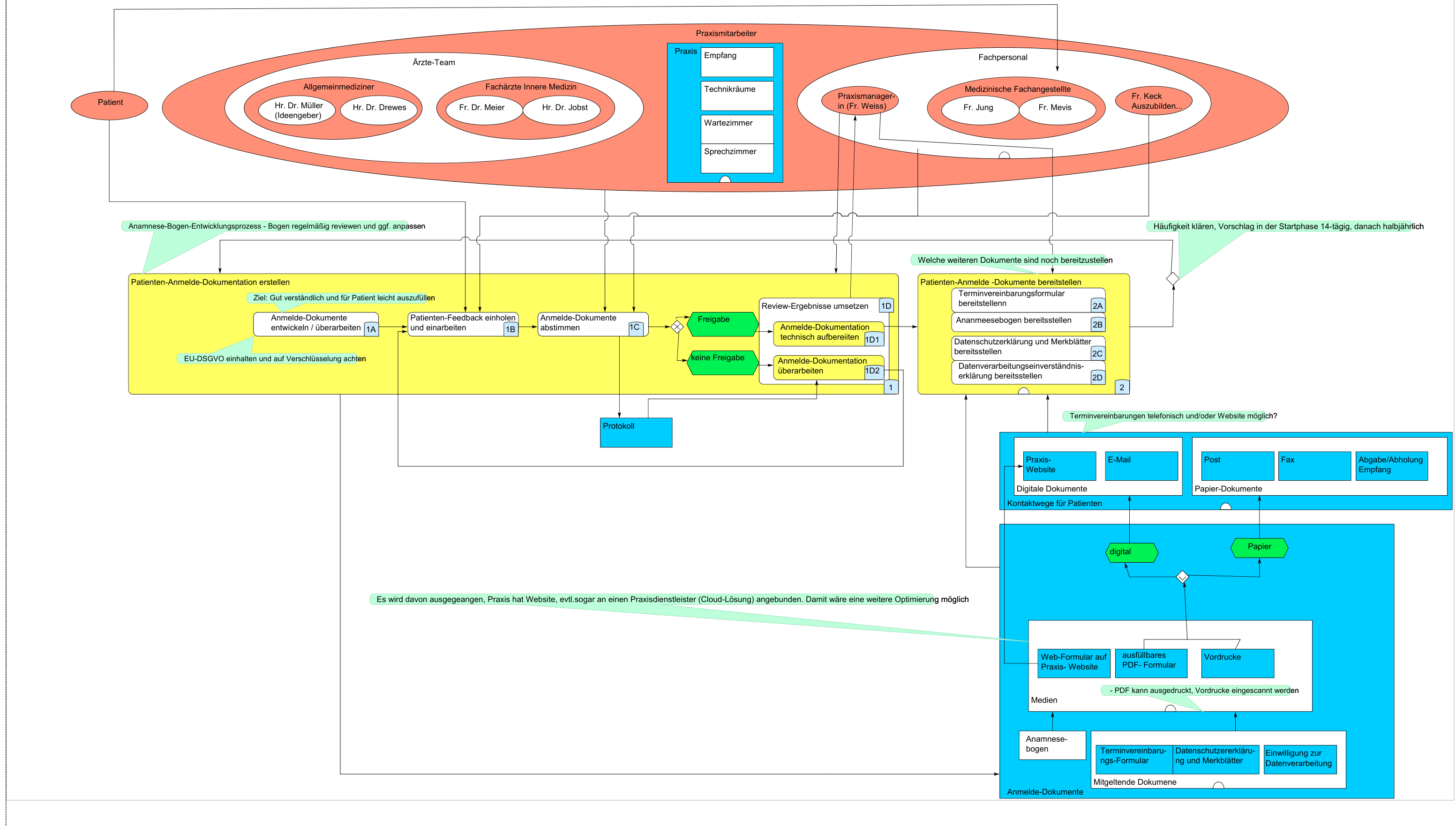
Brief description: This sub-process ensures that good documents exist in the first place. It describes how the medical history form and the accompanying documents are developed, trialled with patients, agreed within the team and then made available in digital and paper form.
Enlarge the diagram: registration documentation as a full-resolution image
The practice manager prepares the documents. Long-standing patients fill them in on a trial basis and point out where they get stuck; this feedback must be incorporated. The team then votes on the draft, with a trainee taking the minutes. Once the draft has been approved, it is prepared for post, e-mail and the practice website; otherwise it is revised. For the initial phase I suggest reviews every 14 days, later every six months. Because health data is involved, data protection and encrypted transmission must be considered from the outset.
Model 2: The registration process
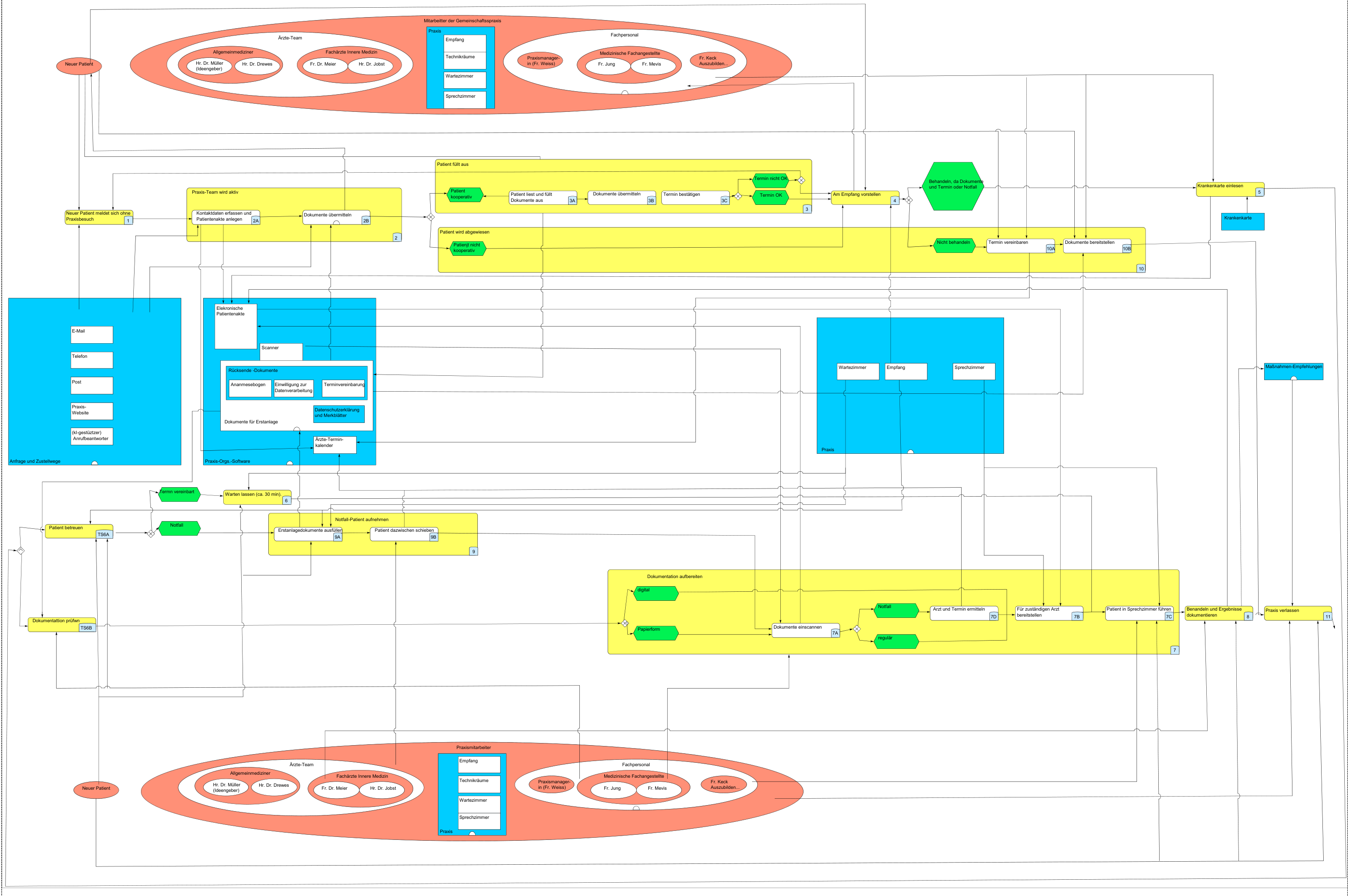
Brief description: The registration process describes a new patient's path from first contact to treatment – with the aim that the medical history and the health insurance card data are already on the doctor's screen at the first appointment.
Enlarge the diagram: registration process as a full-resolution image
As early as when the appointment is made, the practice team creates the patient record, assigns a doctor and sends the documents by whichever route the patient prefers. The patient fills them in at home and sends them back. At reception, two things happen at the same time: the patient is looked after, and the documents are checked. Paper forms are scanned so that the doctor can find everything in the electronic patient record.
One rule in this model is deliberately clear-cut: anyone who is neither an emergency nor has an appointment or completed documents is given an appointment and the documents – and is not treated for the time being. Emergencies are admitted and squeezed in. This rule is debatable and has to be communicated in a friendly way; anyone who needs help filling in the forms gets it from the practice team.
As targets I have set: more than 80% fully completed forms, more than 80% of forms that can be processed electronically straight away, an average waiting time of under 30 minutes and fewer than 5% of patients turned away. For the start-up phase I am allowing about three months, during which the effort will initially tend to increase.
Model 3: Managing stock levels and reordering
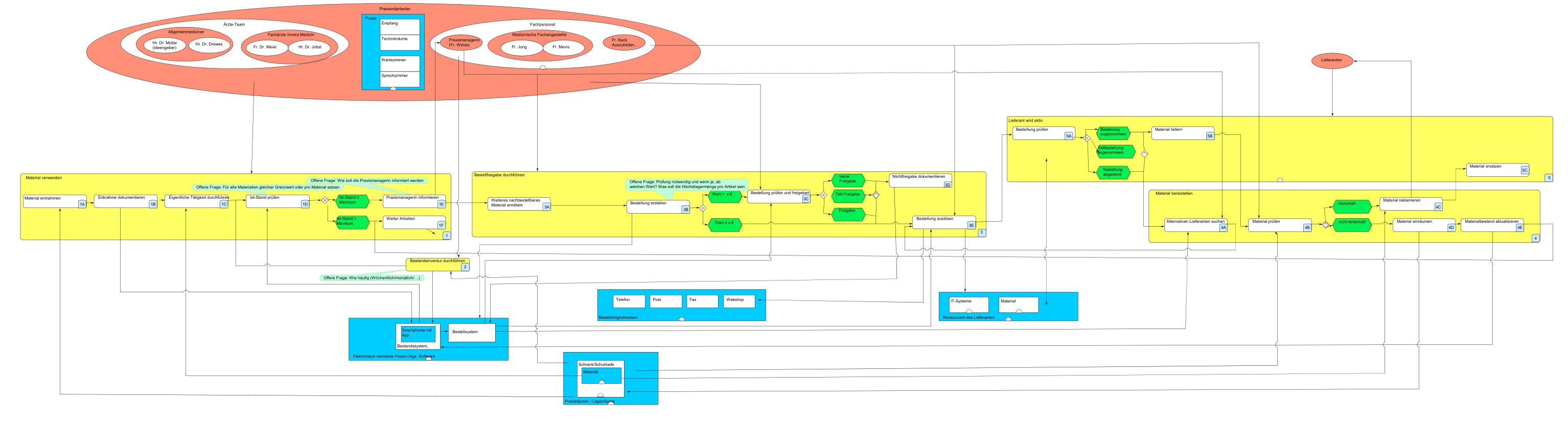
Brief description: This model describes the cycle from taking supplies out of stock, through checking stock levels, approving orders and delivery, to receiving the goods – so that reorders are planned rather than hectic.
Enlarge the diagram: ordering process as a full-resolution image
Every withdrawal is documented. When an item reaches its minimum stock level, the team informs the practice manager, who bundles the order and tops the stock up to the maximum level. Above an order value still to be defined, a second person checks the order. On receipt, the goods are inspected, faulty items are returned with a complaint and the stock level is updated. Because experience shows that withdrawals are not always recorded in day-to-day work, a regular stocktake is part of the process.
To get started I suggest a simple stock system in Excel or Access: quick to implement, but error-prone and only justifiable with proper data backup. In the long term, it is worth talking to the provider of the practice software about integrated modules. With cloud solutions, stricter data protection and security requirements apply because of the patient data. Possible KPIs: delivery time under four days, internal approval in under 36 hours, fewer than five orders per month.
How the models are structured
I created the models with SeeMe. Roles and people appear as orange ovals, activities as yellow boxes, and resources such as documents, rooms and systems as blue areas. For each process step there is a description in table form with the roles involved, the resources and the conditions for the next step. Open questions – for example threshold values, how often stocktakes should take place or whether a four-eyes principle is necessary – I have deliberately marked as open rather than filling them with false precision.
People in the process
Each process comes with a stakeholder matrix covering interest, influence, attitude, expectations, risks, opportunities and measures. It showed me the weak points that a pure flow diagram conceals:
- New patients might find the form too bureaucratic or hard to understand. So: gather feedback and offer help.
- In the start-up phase, the workload for the team rises before it falls. So: reviews, involvement and open communication.
- The trainee might fear being saddled with unpopular tasks such as the stocktake. So: training and an opportunity to develop the system further.
This is the question I ask on every level of my 8-Level Model: Does it serve people – or only the system? A process only lightens the load if the people who live it also support it.
What I recommend
- It pays to separate developing a process from running it: first good documents, then a clean workflow.
- KPIs belong in from the start – and so does a realistic start-up phase.
- A simple quick win and a long-term solution are not mutually exclusive.
- Leaving open points visible is more honest than a precision that does not yet exist.
If you would like to bring order to the workflows in your organisation, you will find what I offer under process management.
Thinking further
You can find more on this topic under process management consulting – or talk to me directly in a free initial consultation.
Comments
Comments are published immediately with your name. Only the name, title, comment text and time are stored – see the privacy policy.
Loading comments …