
This article was created with the AI assistant Claude and published by Peter Hoenig.
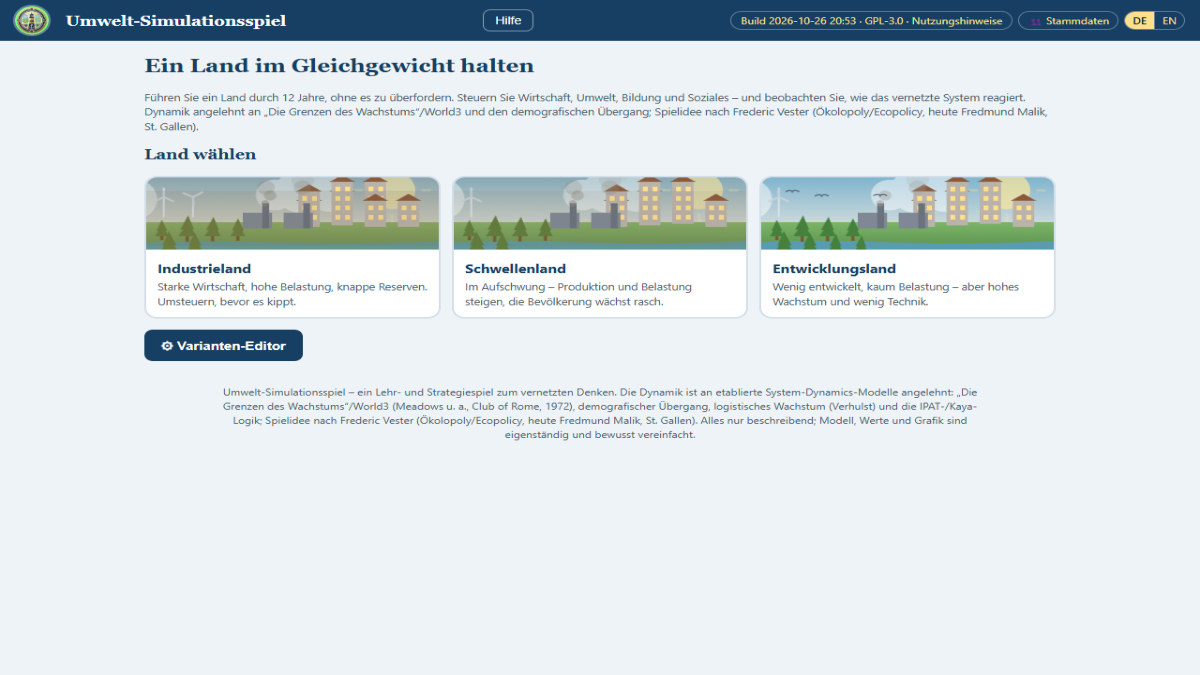
Most games reward quick reactions. This one rewards the opposite: thinking ahead, considering side effects and being patient. Among the small collection of games in my tools you will find the environment simulation game – a learning and strategy game about networked thinking. It runs in your browser and transmits nothing.
At a glance
- You lead a country over 12 years and allocate action points each year.
- You steer four levers yourself: Remediation (environmental protection), Production (the economy), Education (schooling and technology) and Quality of life (health and social affairs).
- Four quantities emerge from that through feedback loops: Politics (your political support), Environmental burden, Reproduction rate and Population – together with affluence, resources and technology.
- Landscape, readings, advisers and history curves show after each year how the system has responded; occasionally an event occurs.
- Three country types and a variant editor (starting values, number of years and coupling strength freely adjustable, and saveable).
- Free and local: free of charge, free software, nothing leaves your browser.
How to play
Each year you have a limited number of action points to distribute across your four levers. The game then works out the consequences: betting on production alone drives up the environmental burden and depletes resources; remediating everything leaves you without economic strength. The aim is not a quick record, but keeping the country in balance over twelve years.
What makes it compelling is that the quantities influence one another – often with a delay. A decision only takes effect years later, and sometimes exactly the opposite way from what you expected. Short-sighted growth can lead to overshoot and collapse; far-sighted steering to lasting affluence. If you lose your political support or the environment tips over, the game ends early.
What lies behind it
The game is deliberately simplified, but based on established models: on the study "The Limits to Growth" and the World3 world model (Meadows et al., Club of Rome, 1972), on the demographic transition, on logistic growth (Verhulst) and on the IPAT logic of environmental burden. The idea for the game goes back to Frederic Vester's Ökolopoly, or Ecopolicy (today with Fredmund Malik, St. Gallen). What this means in detail I explain for everyone without prior knowledge in a separate post: Networked thinking – why simple cause and effect often leads you astray.
In short
A game that invites you to pause rather than to rush – an independent implementation and free of charge as free software under the GPL: Open the environment simulation game. The models and names mentioned are mentioned only descriptively. If you want to understand your organisation as a system and shape it so that it serves people, do get in touch with me for a free initial consultation.
The environment simulation game is a simplified learning and thought model, not a scientific forecasting tool.
Thinking further
You can find more on this topic under Ressourcen und Downloads – or talk to me directly in a free initial consultation.